What is Off Page SEO
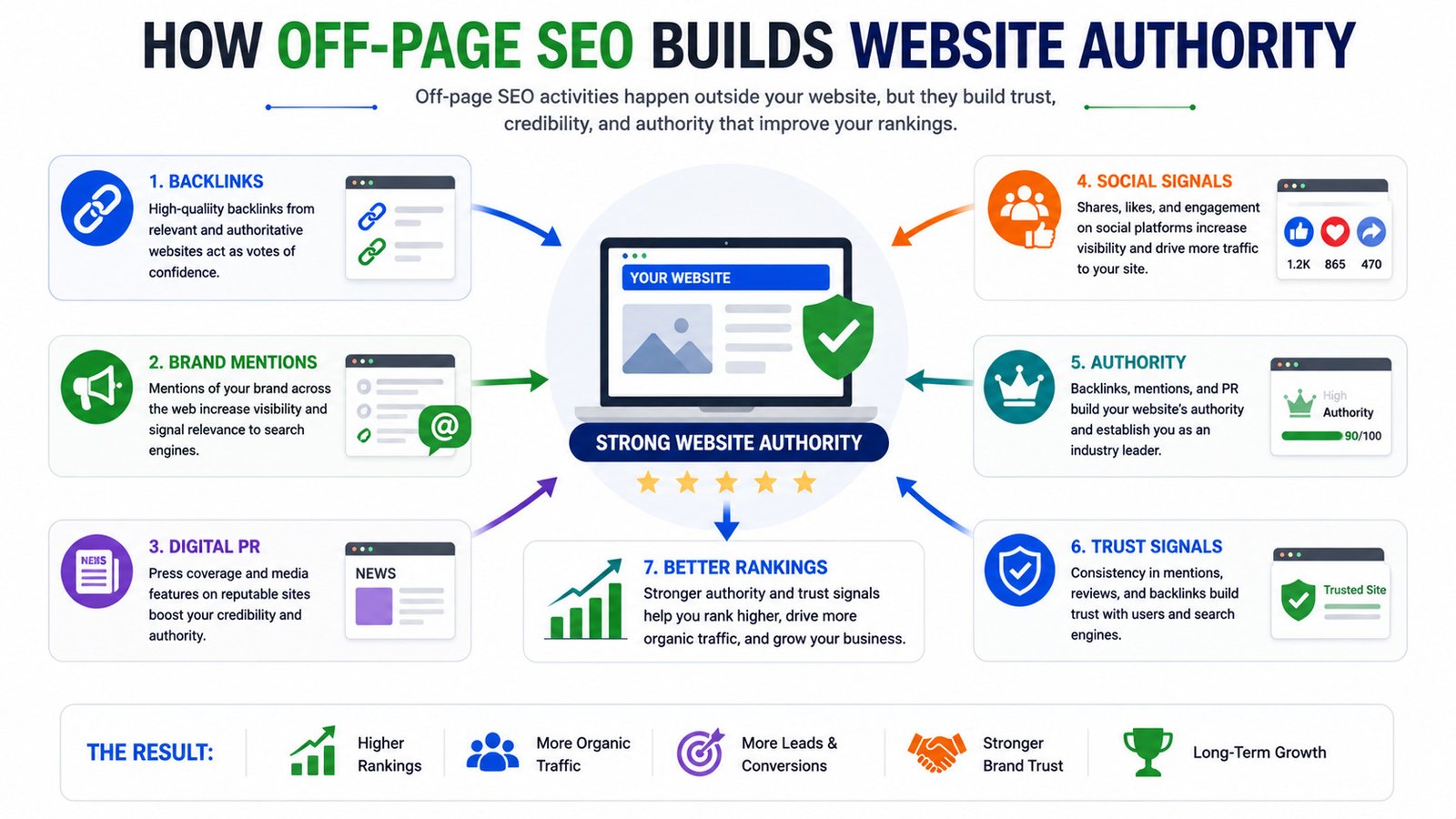
Are you wondering what is off-page SEO? It is the process performed outside your website. The activities help improve the search engine’s rankings and build the overall online reputation. In simple terms, off-page SEO is about earning audience trust, building your website’s authority and credibility through factors external to the site.
The easiest off-page SEO definition is the process of improving a website’s overall visibility. It is done by earning backlinks. Other elements include brand mentions, social signals, and other factors that help build online recognition on third-party websites.
Many search engines, like Google, value these signals as the primary indicators of whether your content is trustworthy or valuable to the audience.
To understand off-page SEO meaning, consider your website’s reputation online. When high-value websites link to your pages, mention your brand, or share your content, it highlights to search engines that your web page has useful information for users. It can also help improve rankings, drive organic traffic, and build domain authority.
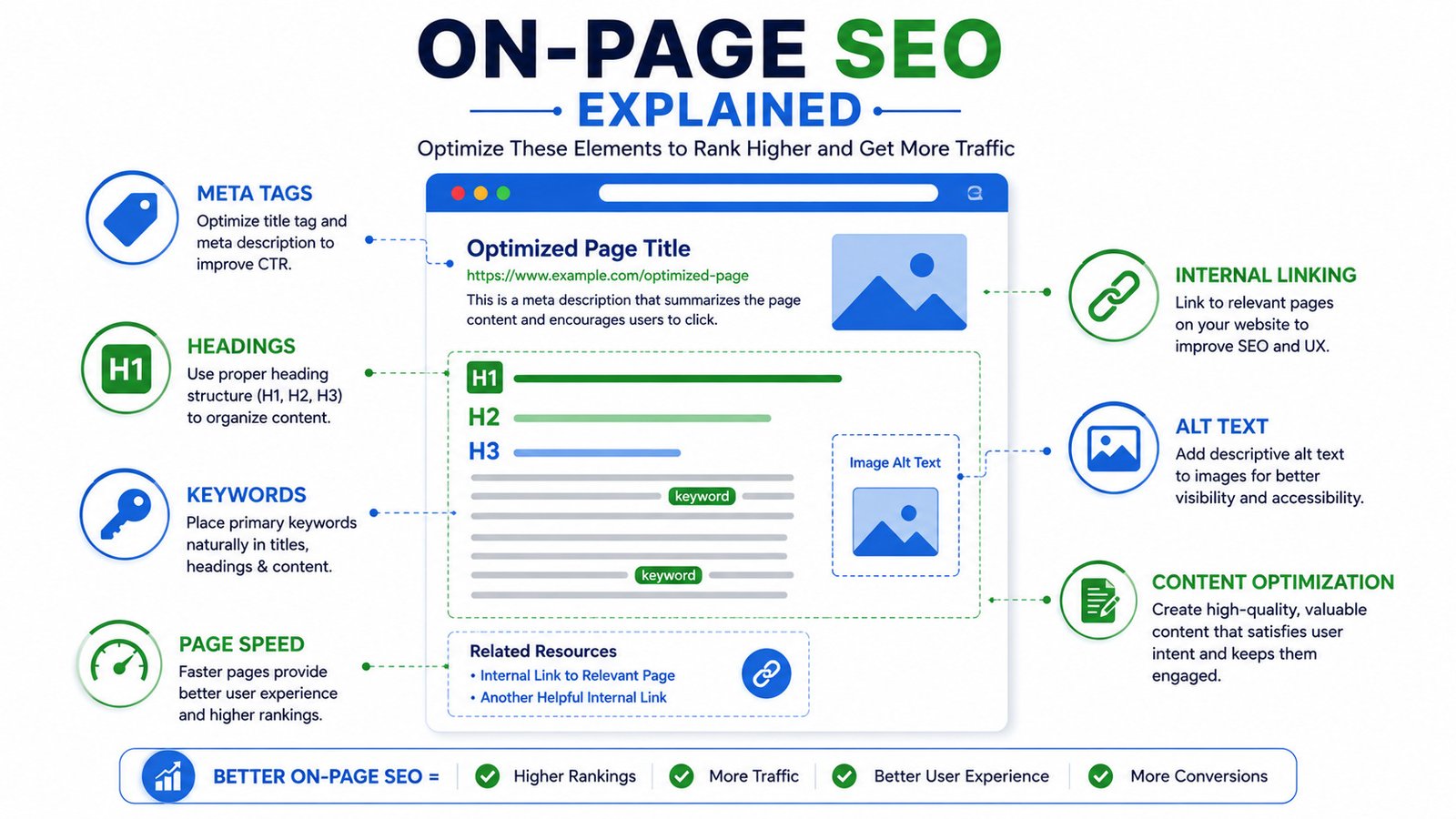
Off-page SEO is not the same as that of an on-page SEO. While on-page SEO focuses on optimising elements on the website, such as keywords, content quality, meta tags, and headings, off-page SEO focuses on actions taken off-site. Both help in strengthening the website’s authority and credibility.
A balance of on-page and off-page SEO explained here, works wonders for the business and is an essential pillar of a successful SEO strategy.
Why Is Off-Page SEO Important?
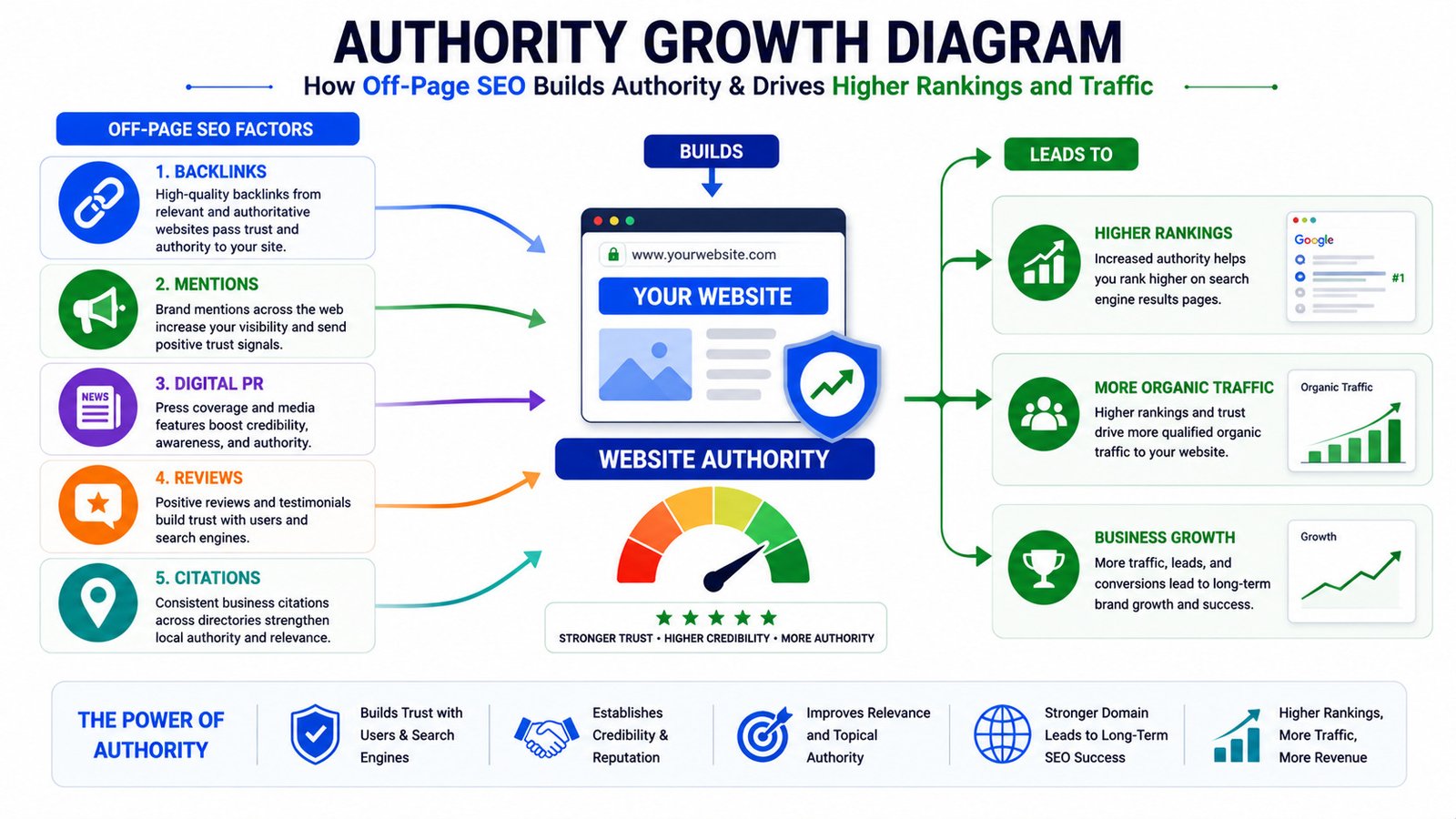
Understanding the importance of off-page SEO works is essential for any business seeking to improve its digital presence and search engine rankings. On-page SEO helps optimise the website internally. Whereas, off-page SEO tends to strengthen the website’s authority and reputation across the digital space. Search engines use these external signals to determine whether a website is relevant, trustworthy, and adds value to users.
One of the biggest benefits of off-page SEO is the authority-building factor. When reputable websites link back to our content from your website, it is viewed by the search engine. The search engine later ranks the website as credible and reliable. These backlinks serve as recommendations that help improve domain authority. It also increases the chances of ranking the website higher on the search results.
Off-page SEO is also one of the major factors that help in building trust signals. When your website receives mentions from trusted websites, positive reviews, quality backlinks, and social media engagement signals, it signals to search engines that the business or brand is reliable. This trust can directly help determine how the website performs relative to competitors’ search rankings.
The second benefit of off-page SEO is online visibility. Strong off-page SEO strategies help your content reach a wider audience. These are done through guest posts, social sharing, influencer mentions, and online communities. The more your brand appears across relevant platforms, the more visibility it also increases online.
Off-page SEO tends to generate more valuable traffic through referrals. When users click links from blogs, external websites, forums, or directories and land on your website, it builds targeted traffic. Additionally, it creates more opportunities to generate leads and drive conversions.
In many competitive industries, websites with strong off-page SEO tend to outperform their competitors. They are known to perform well, especially in terms of authority. A balanced SEO strategy combines both on-page and off-page optimization. It helps businesses build long-term online visibility, improve rankings, and establish a strong digital presence.
How Off-Page SEO Works
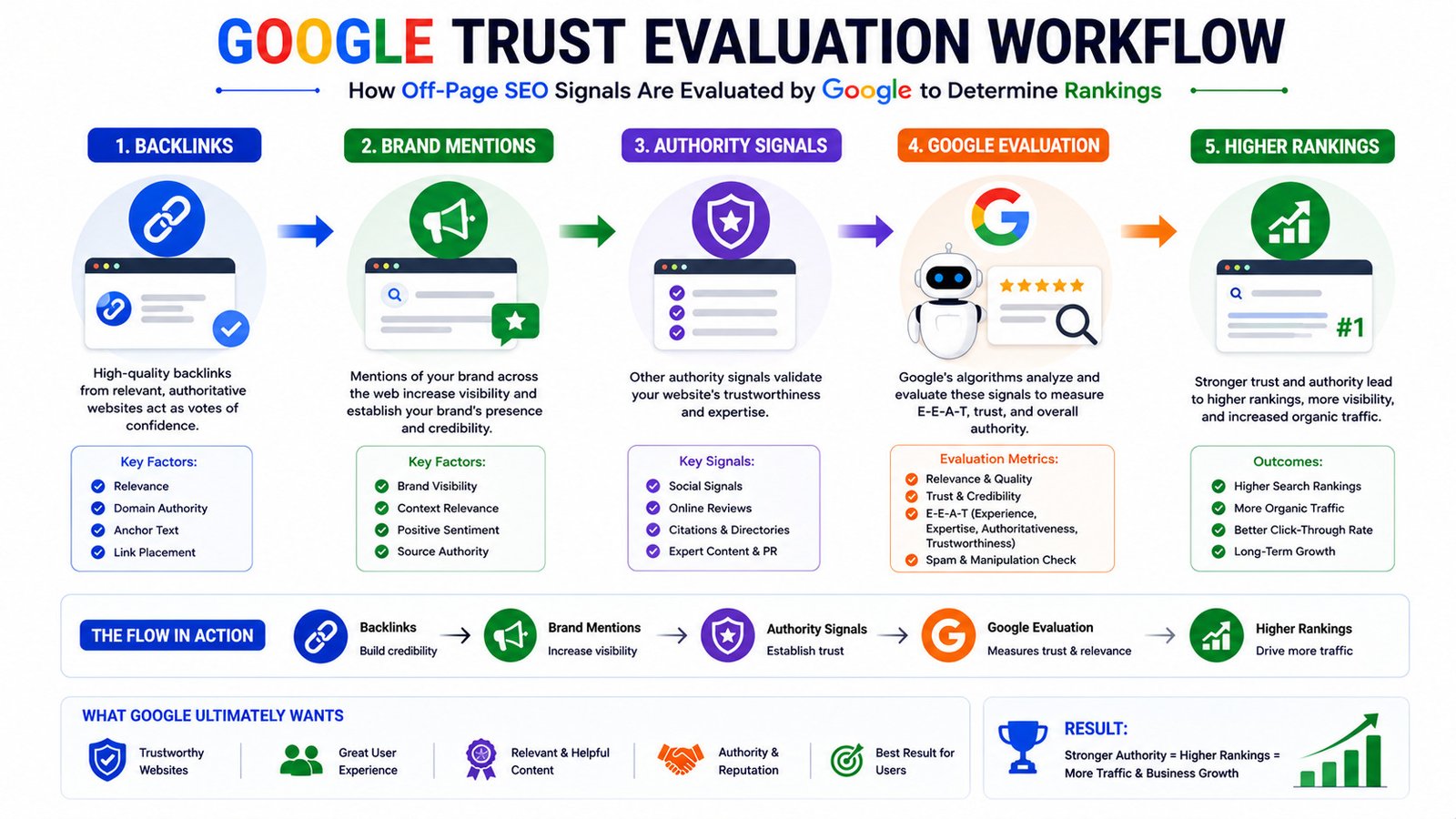
Off-page SEO helps search engines learn about the website. It helps search engines determine whether a website and its content are trustworthy and authoritative compared to other websites online. Most search engines, like Google ranking factors, use many external signals to determine whether content should be valued or ranked highly in search results. Some of the common external signals used by search engines include mentions by brands, online reputation, backlinks, topical relevance and user engagement across the digital space.
A strong off-page SEO strategy not only helps in upscaling the website’s credibility, but it also impacts the website’s search rankings and the organic traffic it receives. Gaining an understanding of how these external signals work can help businesses build an effective SEO strategy.
Here are ways off-page SEO works:
Search Engine Evaluate Authority
Website authority is a key ranking factor for Google. Here, search engines evaluate how other websites interact with the business’s content. It determines if the site is valuable and can be relied on for information. Websites that receive consistent mentions, engagement and backlinks from many authoritative sources are valued and considered as trustworthy by search engines.
For example:
If many trusted blogs link to your website, the search engine will value this as a positive signal. Here, these signals help build stronger website authority and improve the search engine’s ability to rank for competitive keywords.
Search engines also analyse the quality of the websites that are linking to your content. Receiving a backlink from a relevant, trusted website adds more value than receiving multiple low-quality links from unrelated sources.
Backlinks as Trust Signals
Backlinks are the strongest among the trust signals SEO uses to measure your website’s credibility. A backlink is a link from another website to your content. These links advertise or promote your website, telling the search engines that your content is worth recommending and is useful.
Yet not all backlinks are valuable. Search engines place more emphasis on the quality than on the number of backlinks a website receives. Links received from authoritative and relevant websites have a stronger impact on your website rankings than those from irrelevant or spammy links.
For example:
A backlink received from a news site or an industry publication can help in improving your website’s authority. At the same time, low-quality links received from suspicious or spam websites can negatively impact your SEO performance.
Hence, building high-quality backlinks through digital PR, guest posts, valuable content and industry collaborations is key to successful off-page SEO.
Brand Reputation & Mentions
Another factor that search engines consider in successful off-page SEO is brand signals. These help analyse a website’s online authority. Brand mentions across social media platforms, websites, online directories, and blogs help search engines understand how popular your business is and its reputation online.
When a website receives mentions from reliable, reputable brands, even when they do not link directly to your site, it can help build online credibility. They also help in scaling up search ranking. These include social media discussions, positive reviews, and online engagement, which support successful off-page SEO.
A strong brand reputation also helps to increase trust among search engines and users. Businesses that receive and are mentioned by credible platforms are viewed as reliable and authoritative.
Topical Relevance Signals
Topical authority is another factor in off-page SEO. Most search engines evaluate if your website is consistently associated with a specific industry or topics. If your business receives a reference to your content on other authoritative websites, it helps strengthen your content’s relevance to search queries.
For example:
A digital marketing website receives backlinks from marketing publications, SEO blogs and other business websites. These signal topical relevance. It helps search engines to learn about the website’s expertise within the niche subject area.
Building topical authority requires publishing valuable content to earn more niche-related backlinks. It also helps maintain a strong presence in the industry. These signals thereby help improve search engine rankings and enhance long-term search performance.
Link Building Explained
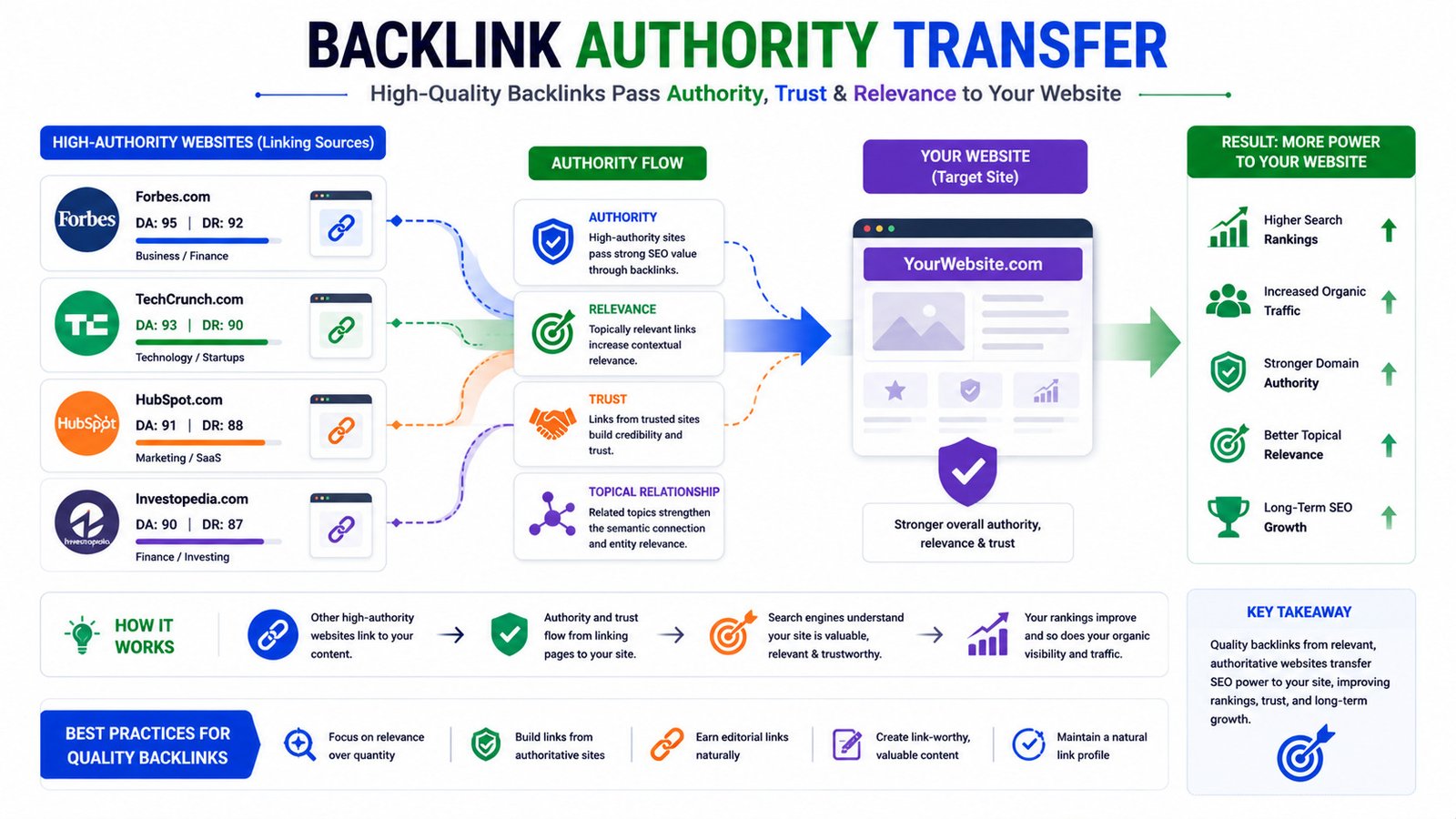
Link building is important for off-page SEO. It is the method of earning links from other websites to link back to your website. These links are called backlinks because they signal to search engines the overall trustworthiness and value of your content.
In short, when a website links to your page, the search engine views it as a recommendation. Search engines use these recommendations as signals that your content is credible and useful to the audience. Hence, backlink building plays an essential role in enhancing overall search rankings and increasing the website’s authority. This thereby also brings credible organic traffic for your business.
In modern SEO, backlinks are not about the quantity of links your website collects. Search engines focus on the overall quality of the link, its relevance and the authenticity.
How do Backlinks Help in Passing Authority
Backlinks transfer the authority from one website to another. Whenever an authoritative or trusted website links to your website content, it passes its credibility to your website. This is the process referred to as “link juice” or ” link equity“.
For example:
Your website publishes high-quality, relevant content. A well-known industry in your niche links to your article through their blog. Herein, the search engine views the link as a positive trust signal. Moreover, the stronger the authority of the website referring to your content is, the more benefits it can bring to your SEO performance.
Hence, businesses and marketers tend to focus on earning high-authority backlinks from trusted websites across the industry. Links received from educational platforms, news websites, government sites, or even established industry blogs can help strengthen your overall SEO performance.
In addition, backlinks from low-quality or spam websites provide very little value to your website. It only harms the overall ranking and turns it more manipulative.
Why Quality Backlinks Matter More Than The Number of Backlinks Received
In the early days of SEO, websites were ranked based on the number of backlinks they received. However, today the SEO scenario is different. Search engines are smarter. They look for quality backlinks over the thousands of low-value links.
Earning a few quality backlinks is way more beneficial than purchasing several links that are not only unrelated but also from weaker websites.
For example:
Suppose A runs a fitness website. A earns a backlink from a renowned health magazine. It will carry more value compared to the backlinks he has earned from several random blogs or unrelated directories. Search engines value genuine links. They try to determine whether the link received is from a relevant industry within the niche, caters to the audience, and aligns with the content topic.
Relevance improves the user experience. Many visitors who go on to click the backlinks from related websites are more likely to land on your content. Besides, they will also engage with your business.
Hence, successful link building is more about earning natural links from topic-related, trustworthy sources than chasing thousands of unrelated links.
What Are Natural Backlinks?
Natural backlinks are those that websites voluntarily give when they find your content informative, genuine, and valuable. These links are considered trustworthy because they are earned organically rather than manipulated or bought.
For example:
If a blogger references your guide as a resource or a new website mentions your overall research in their article, those are considered natural backlinks.
Search engines tend to value natural links because they reflect a website’s trust and authority. The best way to earn them is to build high-quality content that people want to share and reference.
Content, including original research, detailed guides, infographics, case studies, and statistics, often attracts natural backlinks.
Strategies for Link Building
Businesses use several ethical link-building techniques to improve SEO performance. Some of the effective strategies for link building include:
- Guest posting on reliable websites in your industry
- Creating shareable content
- Opting for digital PR and media outreach
- Earning more mentions from reputed industry publications
- Listing businesses in trusted directories
- Building ties with influencers and bloggers
- Consistently publishing research reports
- Including content that is backed by data and statistics
These strategies help websites gain more backlinks and strengthen the brand’s visibility and authority.
What Makes Link Building Important for SEO?
Strong link building enhances a website’s rankings. It helps websites gain credibility, attract more referral traffic, and increase their brand exposure. Besides, it helps build industry authority.
Search engines use backlinks as a strong ranking signal. These links help identify whether websites can be trusted. Websites with strong backlink profiles tend to rank higher and perform better for competitive keywords. In addition, they also drive organic traffic.
When implemented correctly, backlink building is a long-term investment for your website and business. Rather than focusing merely on spam tactics and shortcuts, businesses must prioritise earning more trustworthy, relevant, and high-quality backlinks to support SEO success.
Types of Backlinks in SEO
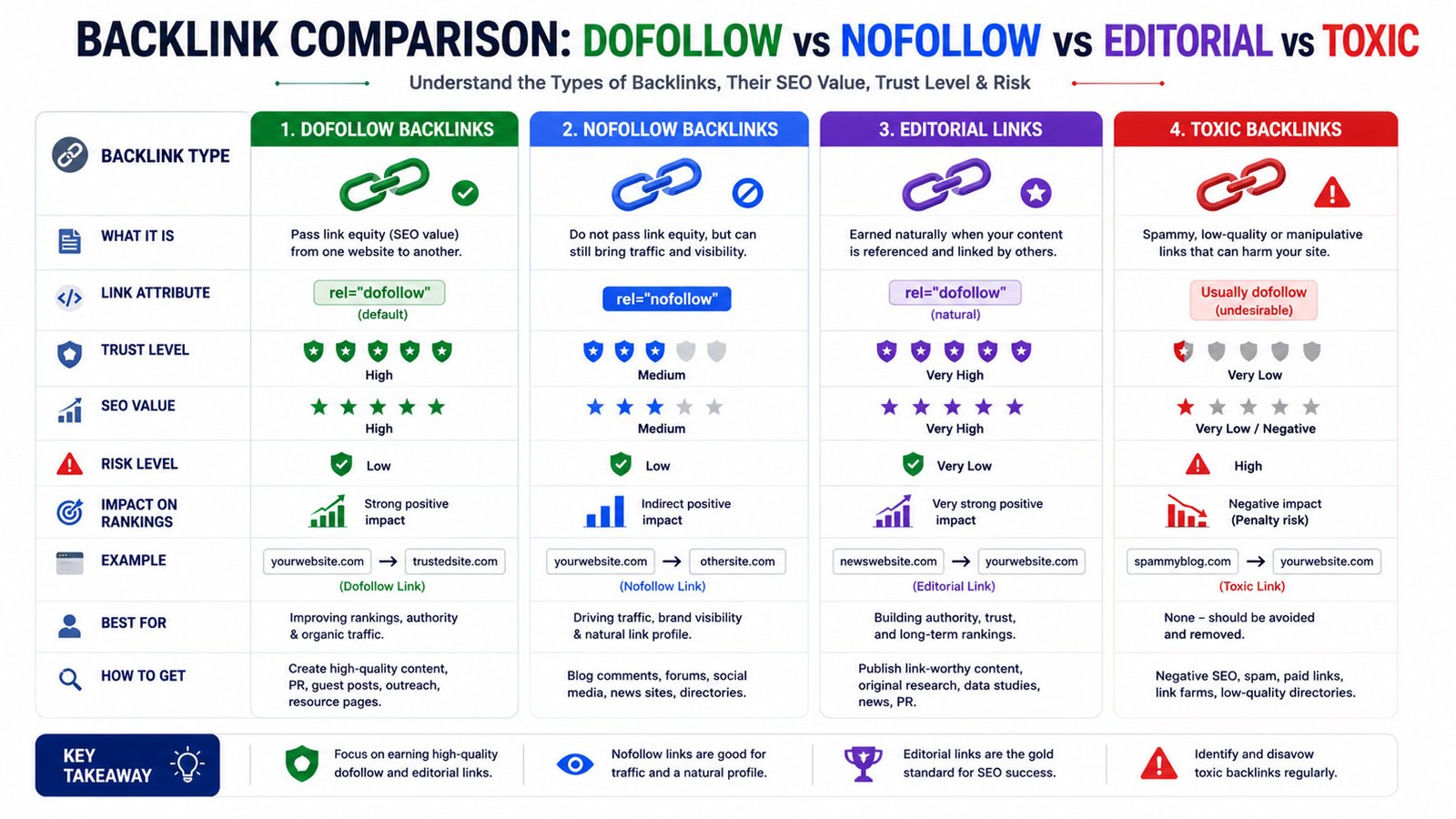
While some backlinks improve rankings and authority, others may add little value or even harm the website. Here are the main types of backlinks commonly used in SEO:
Dofollow Backlinks
Dofollow backlinks are the most valuable type of backlink for SEO. They enable search engines to pass website authority. These types of backlinks are called link equity, which is received from one website to another.
Whenever an authoritative website provides a dofollow backlink to your content, the search engine treats it as a recommendation from the website. It helps in scaling your website’s domain authority.
For example:
A runs a reputable industry business. A renowned blog uses the article with a dofollow link. Here, the website that links to A’s blog will transfer some of its website authority to A’s page. Hence, SEO professionals focus on earning high-quality dofollow backlinks from relevant, trusted websites.
Dofollow backlinks are earned through:
- Guest posting
- Digital PR campaigns
- Creating valuable content
- Mentions in editorials
- Industry collaborations
The quality and trustworthiness of the websites linking to your content will play an essential role in determining the SEO value of these links.
Nofollow Backlinks
NoFollow backlinks contain special tags. These prevent search engines from passing link equity directly to the linked website. Although these links do not transfer any of their authority, as dofollow links do, they do add value in multiple ways. These include:
- Drive referral traffic
- Scale up brand visibility
- Improve the online exposure.
Create a natural link diversity
Search engines expect websites to have a balanced backlink profile. They must include both dofollow and nofollow backlinks. A website with only dofollow links may be viewed as unnatural by search engines.
Nofollow links are commonly used in:
- Social media platforms
- Forums
- Sponsored content
- Blog comments
- Online directories
They may not be useful in boosting the rankings. Yet nofollow backlinks naturally contribute to scaling your SEO strategy.
Editorial Links
These are the highest quality backlinks in SEO. Websites naturally earn them through references to your content. The websites tend to refer to your content in their articles because they find it informative, useful, and valuable.
For example:
A journalist cites your research content, or a blogger refers to the guide you published on your website as a trusted resource. As these links are given voluntarily, not paid for, or requested, search engines value them more and find them more credible when analysing trustworthy signals.
Editorial links are also useful because they come from relevant and authoritative websites. They help strengthen the website’s ranking and build industry credibility and authority.
Businesses often earn editorial links by publishing:
- Case studies
- Detailed guides
- Original researched content
- Insights by experts
- Industry-backed statistics
- Infographics
High-quality content increases the opportunity to earn more natural editorial backlinks over time.
Toxic Backlinks
These links negatively affect SEO performance. They are either spam, irrelevant, or low-quality websites created to manipulate search rankings. A few examples of toxic backlinks are:
- Paid link schemes
- Links earned from spam directories
- Irrelevant links from foreign websites
- Automated network of backlinks
- Suspicious links from gambling or adult websites
Many toxic backlinks can weaken your profile. This may even make search engines levy penalties on your business.
Regular auditing of backlinks helps search engines in finding harmful links. Businesses can remove these links when they are no longer necessary. Having a natural, clean backlink profile is essential for long-term SEO success.
Understanding the types of backlinks can help businesses build a strong off-page SEO strategy. In addition, it will help them avoid practices that could damage their website ranking or affect their online authority.
Best Off-Page SEO Techniques
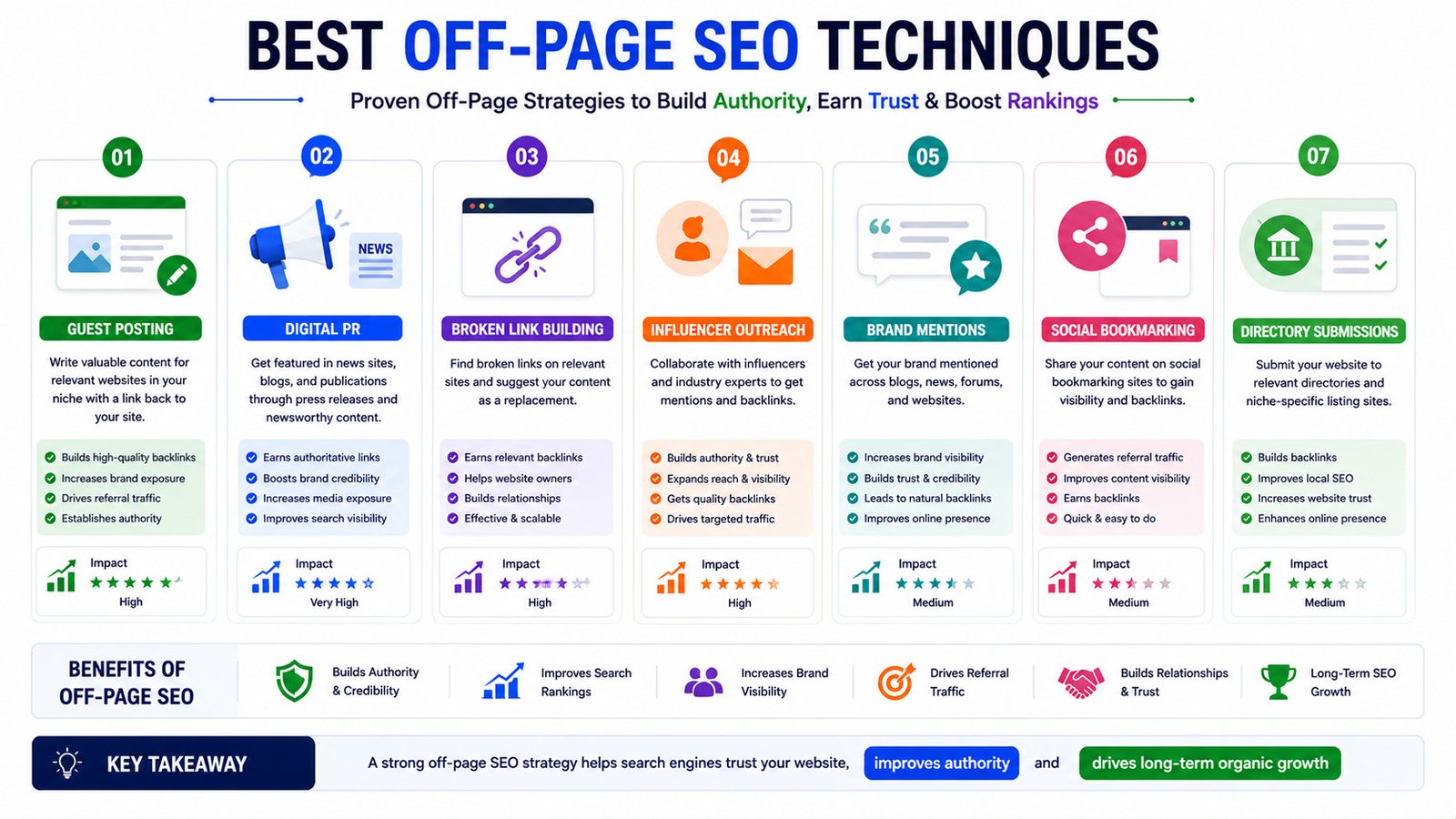
Strong off-page SEO techniques help businesses improve their search rankings. In addition, they help strengthen the website’s authority and increase online visibility. Off-page SEO tends to focus more on building search engine trust and credibility. To do this, it uses external signals such as brand mentions, backlinks, online reputation, and social engagement.
On the other hand, modern SEO focuses on generating quality backlinks rather than random ones. Successful off-page SEO optimisation balances quality, relevance, authenticity, and long-term authority-building.
Below are listed effective off-page SEO activities for businesses to improve their SEO performance. These are:
Guest Posting
Guest posting is a widely used off-page SEO technique. It is the process of writing high-quality and valuable content for another website. In exchange, your website receives exposure, audience reach and backlinks.
This allows businesses to earn high-quality backlinks, improve domain authority, build industry credibility, increase overall referral traffic, and drive new audiences to their websites or businesses.
Successful guest posting is choosing relevant websites within your industry or niche. Search engines value backlinks earned from websites that share the same niche relevance as your business.
Any low-quality guest postings can be viewed as manipulation by the search engines. Businesses must focus on publishing informative content that benefits users.
Digital PR SEO
Digital PR balances both the aspects of traditional public relations with SEO strategies. Together, they help build brand authority and earn high-quality backlinks from online publications and media websites.
In Digital PR SEO, businesses must create newsworthy content, including industry reports, expert opinions, surveys, trend analysis, press releases, and case studies.
The content may be referenced by bloggers, journalists, and publishers who will link back to the website as a source.
Digital PR helps businesses earn relevant, authoritative backlinks. These are received from trusted websites. Thus, it increases the brand credibility on the digital platform. Digital PR is one of the best long-term off-page SEO strategies.
Broken Link Building
Broken link building is identifying broken or outdated links on other websites. They may suggest their own relevant links or content as replacements for the broken links.
For example:
If a website links to a resource that has already been deleted, you can contact the website owner. Moreover, you can recommend your page as an updated alternative.
The strategy benefits the website owner as well as the business:
- Website owners can fix the broken links and improve the overall user experience
- Businesses get to gain relevant backlinks
Broken-link buildings are best suited for businesses that want to provide high-quality content that matches the topical relevance of the missing resource.
Influencer Outreach
Influencer outreach is the method of collaborating with bloggers, influencers and creators from niche industries. It helps increase brand exposure and earn more backlinks and mentions.
Influencers have a strong audience base. They have established authority within their niche. When they refer to your product, service, or content, it improves brand awareness and generates more traffic.
Influence collaborations include product reviews, collaborative content, expert interviews, industry roundups, social media promotions and podcast appearances.
Apart from SEO benefits, influencer outreach also helps strengthen the online reputation and audience engagement.
Brand Mentions SEO
Brand mentions help search engines view it as a brand signal for evaluating the online authority and reputation.
When forums, websites, blogs, or social media platforms mention your brand name, it helps increase recognition and credibility.
For example:
If many websites frequently discuss your business or reference your expertise, the search engine interprets it as a positive authority signal. Businesses can improve their brand mentions SEO by:
- Taking part in industry discussions
- Being active on social media
- Publishing valuable content
- Running PR campaigns
- Building a community presence
Tracking unlinked brand mentions also creates opportunities to request backlinks from websites that already reference or mention your business.
Social Bookmarking
Social bookmarking includes sharing blog posts, websites or articles on bookmarking platforms. This again helps drive traffic and increase visibility. Popular bookmarking websites help users discover and organise useful content online. Sharing these too can increase content exposure, drive more referral traffic, improve indexing speed, and expand overall audience reach.
Although social bookmarking does not directly strengthen ranking signals, it supports off-page SEO by increasing content visibility and distribution.
The key is to share high-quality content rather than just using a bookmarking platform to spam promotions.
Forum Submissions
Forum submissions participate in industry discussions, online communities, and other activities related to your niche. Businesses can answer user questions and share their expertise. In addition, they can contribute their insights while linking to relevant content.
The strategy of forum submissions helps build topical authority, drive referral traffic, and increase industry expertise.
However, forum participation should be about genuine engagement. It should not be viewed as a means of engaging in link spamming. Search engines can analyse unnatural promotional behaviour.
It is recommended to add thoughtful content and participate in niche forums to strengthen your credibility with search engines and users.
Directory Submissions
Directory submissions include listing your business on trusted online directories. It also includes citation platforms. It helps in local SEO.
For example: Adding your business in Google Business Profile, IndiaMART, Sulekha, Yelp, Justdial, or other industry-specific directories.
Consistent availability of information about your business across directories helps search engines to verify the legitimacy of your website. It also improves trust signals.
However, businesses must avoid submitting websites to spammy or low-quality directories. Focus on choosing relevant platforms that add value to users.
Why Off-Page SEO Techniques Are Essential?
Off-page SEO activities help search engines learn more about your website. These include the website’s popularity, authority, trustworthiness, and relevance. A strong off-page SEO optimization strategy improves rankings, builds brand awareness, attracts referral traffic, enhances industry credibility, and drives audience engagement and digital presence.
Successful off-page SEO strategies help build the trust of search engines and users. It ensures the rankings are not manipulated using shortcuts.
Quality and Consistency
Off-page SEO is a long-term activity. It requires strategic effort and consistency. Businesses must look to build valuable content, gain backlinks, maintain a positive online reputation, and use ethical outreach methods.
Search engines value websites that have expertise, trust and authority through online engagement.
Combining digital PR, guest posting, brand mentions, influencer outreach, directory submissions, and other off-page SEO techniques allows businesses to build strong authority and achieve SEO success.
Off-Page SEO for Local Business
Off-page SEO is more crucial for businesses. They rely greatly on local customers and on getting regional visibility. Whether you own a large business, a restaurant, a service-based company, a clinic, a law firm, or a salon, a strong local off-page SEO can be your advantage. It helps improve local search rankings and attracts nearby customers.
Citation building is an important criterion for local SEO strategies. A citation is defined as the online mention of your business. The details include the business name, address, and phone number (NAP) available across various media, such as directories, websites, and local business platforms. Having information consistent across multiple platforms helps the search engine in verifying your business. Herein, search engine designates your business as legitimate and trustworthy.
Some common local SEO citations include – business listings on platforms such as Justdial, Google Business Profile, Bing Places, Yelp, Sulekha, and IndiaMART, as well as other industry-specific directories. The citations must be consistent and proper to improve the website’s local visibility. It also increases the chances of your business to appear in Google Local Search results and map listings.
The second factor in local off-page SEO is customer reviews. Reviews play an important role as local trust signals. Especially positive reviews listed on Google and other platforms serve as indicators for customer satisfaction, business credibility, and overall website reputation. Businesses that have received strong ratings and authentic reviews help gain better visibility in local search rankings.
Reviews also influence customer decisions. Customers trust brands that have positive feedback and active engagement across platforms.
In addition, businesses must also ensure to respond to positive and negative reviews to strengthen their brand trust and customer relationships.
Another factor that contributes to strong local SEO is local backlinks. These links, sourced from newspapers, local blogs, community websites, and regional business directories, help search engines associate the business with its geographic locations.
Hence, focusing on local reviews, citations, community engagement, and local mentions will help businesses build strong local authority. It improves building online visibility, attracts local customers, and builds website authority.
Common Off-Page SEO Mistakes to Avoid
Off-page SEO can improve your website’s authority. When implemented correctly, off-page SEO can also improve search engine rankings. However, using the wrong strategies can also harm your overall SEO performance. Modern search engines are advanced. They can easily track and identify manipulative link-building practices. In addition, using low-quality SEO tactics is easily caught by search engines.
Hence, the need is to be knowledgeable about common mistakes to avoid when building long-term, sustainable search output.
Some of the common mistakes include:
Purchasing Backlinks
Most marketers make the gravest mistake of buying backlinks from link networks or low-quality websites. When buying links, SEO experts may believe it is a quick way to improve rankings. However, this practice only violates the search engine guidelines.
Whether they are paid or unnatural, backlinks can lead to a drop in the overall search rankings and incur penalties. Moreover, there is a risk that your website could be removed from the search results.
Thus, as an SEO beginner, you must invest in earning high-quality and natural backlinks. You must earn backlinks through digital PR, valuable content, and genuine industry relationships.
Spammy Directories
Submitting websites to low-quality directories is yet another common mistake beginners should avoid. There are multiple spammy directories on the internet. They exist to manipulate the search ranks. However, they add very little value to the users.
Modern search engines are smart in identifying low-quality backlinks. These are received from directories. It goes on to weaken the website’s credibility.
Therefore, brands should focus primarily on trusted, relevant directories. They offer better visibility and build relevance among the local audience.
Irrelevant Links
Not all backlinks are beneficial. Getting links from unrelated websites can confuse search engines. This can reduce the quality of your website’s backlink profile.
For example, if a technology website gets backlinks from an unrelated website, such as an entertainment or gaming site, those links can feel unnatural.
Search engines value relevance over the number of backlinks received. Backlinks from websites not connected to the industry or audience can undermine credibility.
Hence, choosing relevant links will improve SEO value and drive more targeted referral traffic to the website.
Over-Optimised Anchor Text
Anchor texts are clickable words. These are used as hyperlinks. Multiple websites repeat the mistake of using exact-match keywords as anchor text in backlinks. This leads to over-optimisation of anchor text.
For example, SEO experts use the same keyword phrase across many backlinks, which search engines consider manipulative. A natural backlink profile uses a combination of generic phrases, branded terms, and varied anchor text.
Hence, maintaining diversity across anchor text creates a more organic profile. It also reduces the overall risk of levying search engine penalties.
Solution – Focus on natural off-page SEO
A successful off-page SEO is one built on relevance, authenticity, and trust. Rather than chasing quick results through unnatural methods, the business must focus on earning ethical links, producing high-quality content, and building a strong brand reputation. Using sustainable SEO practices delivers long-term rankings, enhanced visibility online, and strong authority.
On-Page SEO vs Off-Page SEO
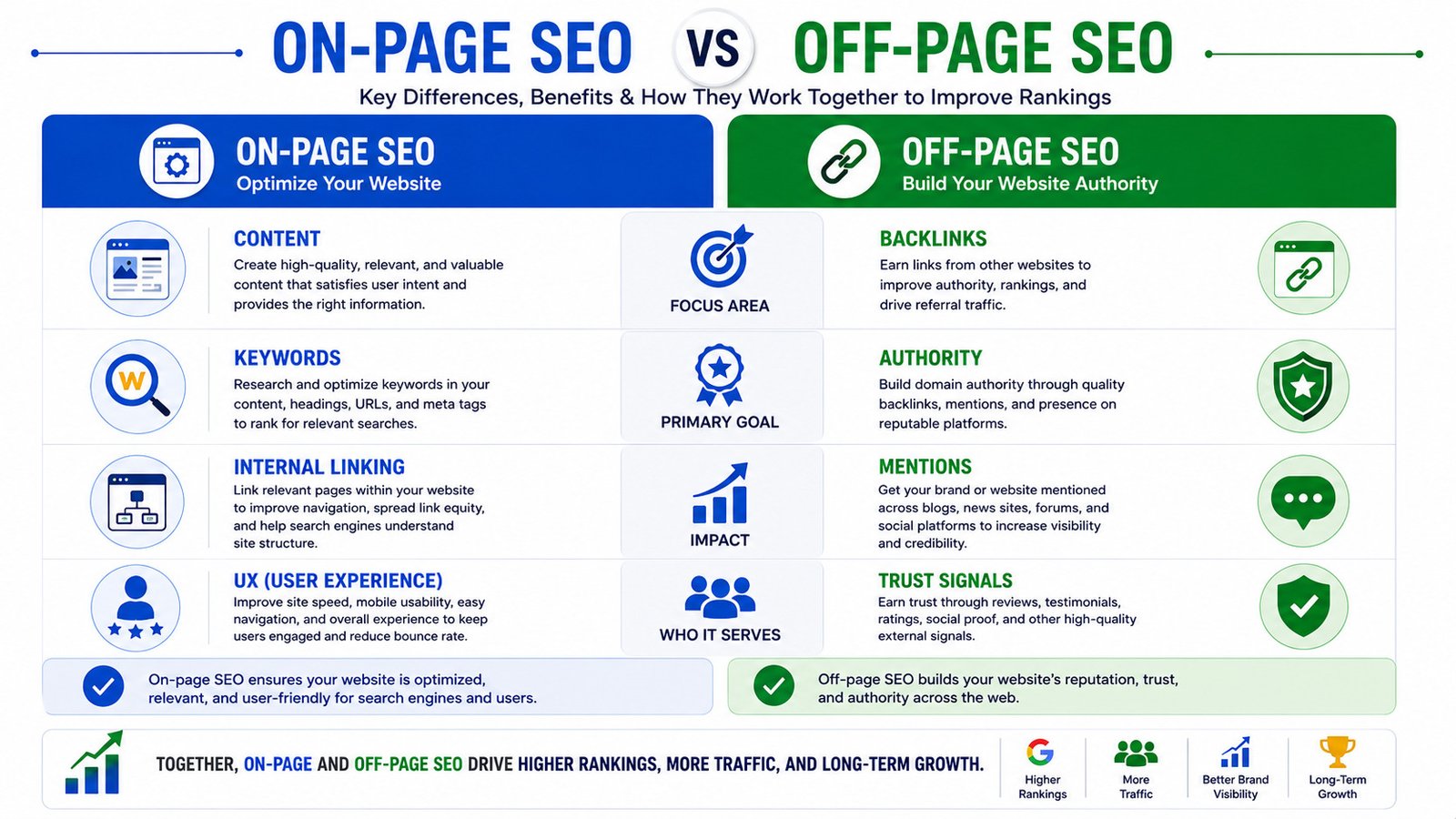
On-page and off-page SEO are important for SEO, or search engine optimization. The strategies serve multiple purposes. When used together, the strategies help build search rankings. It also helps improve the website’s visibility and enhance its online authority.
On-page SEO optimises elements on the website. These factors are keywords, content, internal links, meta tags, and page structure. On-page SEO focuses on helping search engines understand the quality of the content and on improving the user experience.
On the other hand, off-page SEO focuses on factors that are external to the website. It helps strengthen authority and credibility. The factors include positive reviews, review responses, backlinks, brand mentions, good social signals, and enhanced online reputation management.
Here is a detailed comparison of both:
| Feature | On-Page SEO | Off-Page SEO |
| Focus Area | Helps in optimizing websites | Helps in building external authority |
| Purpose | Betters content relevance and user intent | Betters website credibility and trust |
| Activities | Meta tags, internal links, keyword optimization, content quality | Brand mentions, reviews, citations, link building |
| Controlled by | Website owner | External platforms and websites |
| Impact on SEO | Assists search engine in learning about the content | Assists search engines in measuring the authority |
| Examples | Quick loading pages, optimized headings | Reviews, guest posts, backlinks |
On-page and off-page strategies are important for search engines to evaluate the authority and relevance when ranking websites.
For example, if your website has high-quality content and is strong on-page optimization, it may still rank without the need for trust signals or backlinks. Similarly, strong backlinks alone will not improve ranking if the website’s content is low-quality or irrelevant.
An effective balance of on-page and off-page SEO creates a good strategy for websites. It enhances the organic rankings, enhances traffic, and builds credibility. It also supports long-term digital needs. Businesses must thus focus on both SEO areas to achieve SEO success and strong visibility online.
Off-Page SEO Checklist
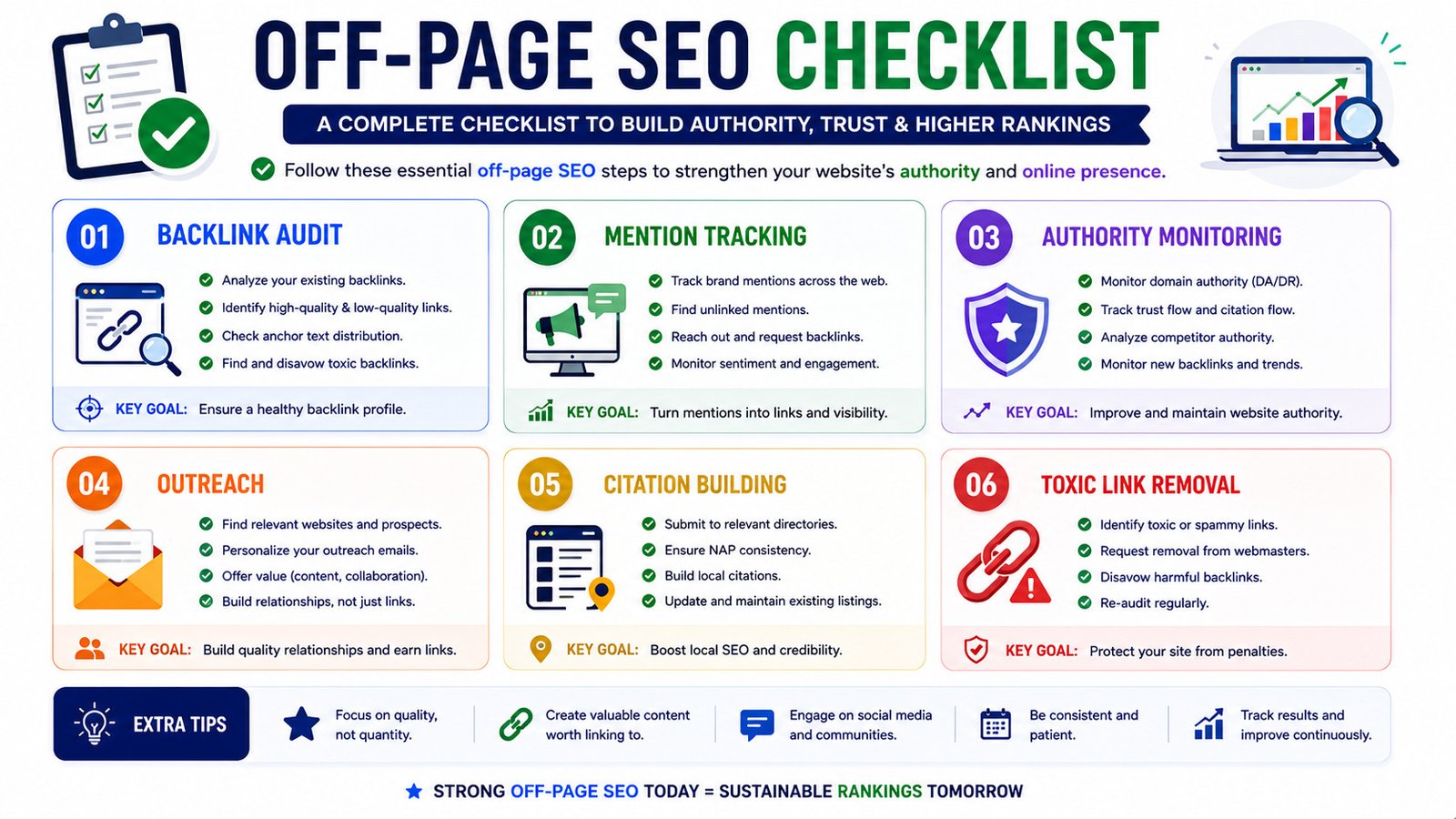
A good off-page SEO cheklist must include an important checklist. It will help businesses improve their overall search rankings, build authority, and strengthen their online visibility. Off-page SEO is not limited to gaining backlinks. It must include proper monitoring of brand reputation. It should also include maintaining link quality and trust signals.
Here are a few off-page SEO best practices. It will ensure that SEO efforts are effective and align with search engine guidelines.
Audit Backlinks
Ensure regular audit of backlinks. It is essential for maintaining a healthy backlink profile. Evaluate the websites that are linked to your domain. In addition, identify any domains that are irrelevant, spammy, or low-quality. These can negatively impact the overall SEO performance.
A backlink audit also helps identify the pages that attract many links and where future link-building opportunities exist. It is necessary to remove toxic backlinks to prevent you from being penalised by search engines.
Build Quality Backlinks
Lay more focus on earning relevant, authoritative backlinks within your industry. A strong backlink not only enhances trust and builds authority but also improves search rankings compared to other low-value links.
Some of the top link-building strategies are:
- Guest posting across trusted websites
- Performing digital PR
- Publishing valuable content
- Collaborating with similar industries
- Getting mentions from publications and other niche blogs
Brand Mentions
Track brand mentions, which are an essential aspect of off-page SEO. An SEO beginner or expert must monitor which areas of digital space the business is discussed in, whether on forums, blogs, news websites, or social media platforms.
Even unlinked mentions tend to contribute to building strong visibility and authority. Tracking mentions helps brands identify opportunities to request backlinks from brands that reference them.
Website Authority Building
Regular website metric monitoring is also related to backlink quality, domain authority, and referring domains. It also includes organic visibility. Authority monitoring helps measure the overall effectiveness of off-page SEO and identify areas for improvement.
Consistency in authority and growth indicates your backlink strategy is strong and that brand-building efforts are effective for the business.
Strong Outreach of Business
Maintaining an organised outreach is important for building links. Reach out to reliable, relevant journalists, bloggers, publishers, and industry websites with personalised communication and valuable content ideas.
A successful outreach will focus on building relationships where you can request links. Businesses that consistently provide insights and high-quality content will earn natural backlinks and help in building long-term partnerships.
Local and Social Signals
You must build citations through customer reviews, directories, and stay active on social media platforms. Positive reviews and local mentions by businesses, in addition to social engagement, help build strong trust signals and improve online reputation.
Following the above-mentioned off-page checklist can help businesses improve authority, increase rankings, and build trust for long-term SEO growth.
Real Off-Page SEO Examples
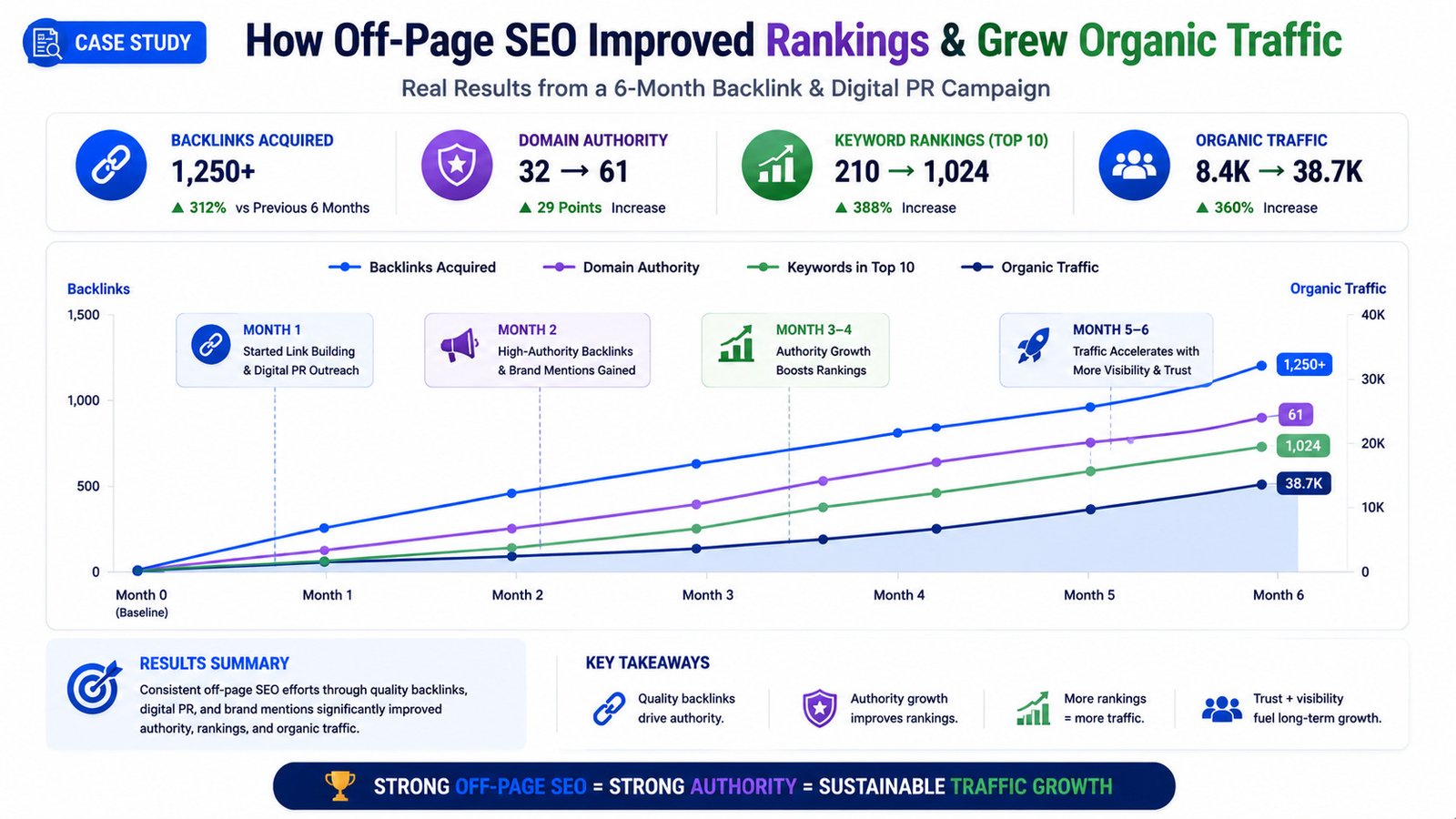
Knowledge of real-world off-page SEO examples can help businesses learn how external SEO strategies can build visibility, improve search rankings, and increase website authority. Effective off-page SEO does not equal backlinks.
It includes earning the trust of search engines, creating valuable content for users, and ensuring brand recognition across digital spaces.
Here are a few off-page SEO examples:
Backlink Campaign
An IT company published a summary of an industry report. It contained market insights and original statistics, and the content offered valuable data—news websites, industry locations, and blogs referenced and linked to the report.
Herein, the company earned many backlinks from highly authoritative websites. Over time, the domain authority also improved. The company achieved increased organic traffic and higher rankings for target keywords.
This shows that creating unique, informative content can build backlinks and strengthen SEO performance.
Digital PR
Digital PR is another example of how an off-page SEO strategy can help a business. For example, an e-Commerce brand launched its campaign. This was during the seasonal shopping trends. Journalists and online publications shared the findings.
The campaign was successful and grew popular on media websites, business magazines, and blogs. The mentions generated strong backlinks, increased brand visibility, and drove more referral traffic to the company website.
In addition, the campaign helped businesses build credibility and attract a wider audience. It demonstrated a combination of content marketing, SEO, and media outreach to build long-term authority.
Authority Building
A pharma company focused on building its authority which is within its industry. Therefore, they published educational blogs consistently and collaborated with other pharma-related websites. They worked by adding guest posts, interviews with experts, and mentions in other blogs and local directories.
The search engine recognized and ranked the pharma company as a trusted source within its industry.
The website’s rankings went on to improve for the company’s local keywords. Additionally, it also received more organic search inquiries.
This example showcases how building authority requires relevance, consistency, and trust signals from reputable sources.
These off-page SEO examples highlight that SEO is more than just technical optimisation. Businesses and brands that focus on content, digital PR, relationship-building, and earning high-quality backlinks achieve higher rankings and sustainable growth.
The key to effective off-page SEO is building strong authority rather than relying on spammy tactics.
FAQs About Off-Page SEO
Q1. Is off-page SEO only about backlinks?
No. The notion that off-page SEO is only about backlinks is false. Backlinks, though, play an essential role in ranking the website. Off-page SEO also involves other factors such as online reviews, earning brand mentions, securing local citations, influencer outreach, social media engagement, digital PR, and building online reputation. These are external signals that help search engines assess a website’s trustworthiness and authority.
Q2. Which backlinks are best?
The most sought-after backlinks are relevant, authoritative, trustworthy, and within the business’s industry or niche. A backlink earned through a news website, industry blog, business directory, or educational platform is more valuable than many low-quality links.
Reliable backlinks are important because they help search engines understand a website’s expertise and topical relevance.
Q3. How many backlinks do I need?
There is no limit to the number of backlinks needed to improve a website’s ranking. However, quality matters over quantity. A website with high-quality, reliable backlinks tends to outperform one with multiple low-value backlinks.
The number of backlinks is more dependent on the overall industry competition. It focuses on the keyword difficulty and the authority of the competing websites.
Instead of merely focusing on more backlinks, businesses should prioritise trustworthy, consistent backlinks.
Q4. Is guest posting still effective?
Yes. Guest posting is a very effective method of building an off-page SEO strategy. Incorporating valuable content helps reliable, relevant websites. They help brands gain quality backlinks, build brand visibility, and drive audience traffic.
However, low-quality posting can lead to link manipulation. It violates search engine guidelines. The focus must be to offer useful content for the real audience.
Q5. Can off-page SEO hurt rankings?
Yes. Poor off-page SEO can negatively affect overall rankings. Here, purchasing backlinks, using low-quality directories, building irrelevant links, or participating in link schemes building which can lead to search engine penalties.
Search engines should prioritise ethical SEO practices. Businesses must avoid shortcuts and focus on building authority through authentic, high-quality content.
Q6. Are social signals important?
Social signals such as comments, shares, likes, and social media engagement are essential. They may not directly improve the rankings. However, they do support off-page SEO traffic. Social media helps increase content visibility, drive traffic, and improve overall brand awareness, creating more opportunities to earn genuine backlinks.
A strong social presence strengthens the brand’s credibility and drives greater audience engagement.
Q7. What’s the safest link-building method?
The best way to build links is to earn genuine backlinks through ethical outreach and valuable content. You must generate high-quality guides, case studies, research reports, infographics, and blogs that encourage websites to link to your content.
Other methods include guest posting on digital PR platforms, websites, industry collaborations, and building relationships with publishers and bloggers. Long-term SEO focuses on relevance, consistent quality, and authenticity to drive quick link building.
Conclusion
Off-page SEO is very important in enabling website authority. It improves search rankings by increasing visibility in the digital space. On-page SEO helps optimise the website internally. On the other hand, off-page SEO helps build a reputation across digital media. These are achieved through brand mentions, citations, backlinks, and the development of trust signals.
Modern-day SEO is more than just keywords, research, and technical optimization alone. Search engines tend to look for credibility, relevance, and user trust. It helps search engines determine whether the website deserves higher rankings.
Hence, businesses must lay more focus on building valuable content and earning high-quality backlinks. They build a strong online presence using ethical SEO practices.
An SEO beginner and a digital marketing expert must follow an authoritative-first SEO approach for long-term success. Rather than charging for spam link building or shortcuts, businesses and brands must focus on building genuine relationships to publish content and earn trust in the digital space and with search engines.
Sustainable off-page SEO strategies improve search engine rankings, strengthen brand reputation and customer confidence, and drive referral traffic.
When used together, on-page and off-page optimization create a balanced strategy that supports long-term search engine success.


Words And Cappuccinos
Words And Cappuccinos is a trusted full-service digital agency specializing in content, marketing, and design. Check out our insightful articles, practical tips, and industry trends to grow your brand smartly.