ChatGPT vs Gemini in 2026: Which AI Assistant Is Better for SEO, Content Writing, Coding, and Business Growth?
Artificial intelligence is no longer a futuristic concept. Today, businesses across industries rely on AI assistants to create content, automate workflows, improve productivity, optimise SEO strategies, and streamline research processes. From startups and freelancers to enterprise organisations, Generative AI has become a core part of digital transformation.
At the centre of this AI revolution are two major AI assistants: ChatGPT and Gemini.
Both are powered by advanced Large Language Models (LLMs) and Machine Learning technologies, but they differ significantly in terms of writing quality, Semantic SEO capabilities, conversational AI performance, multimodal AI integration, and productivity workflows.
So, when comparing ChatGPT vs Gemini in 2026, which one is actually better?
The answer depends entirely on your goals, workflows, and use cases.
This detailed comparison explores:
- ChatGPT vs Gemini for SEO
- ChatGPT vs Gemini for GEO and AEO
- ChatGPT vs Gemini for content writing
- ChatGPT vs Gemini for coding
- ChatGPT vs Gemini for research
- AI workflows and productivity
- Prompt Engineering
- Multimodal AI capabilities
- Pricing comparison
- Limitations of both AI assistants
If you are a business owner, marketer, content strategist, SEO professional, developer, or agency owner, this guide will help you choose the right AI assistant for 2026 and beyond.
What Is ChatGPT?
ChatGPT is an advanced conversational AI assistant developed by OpenAI. It is designed to understand language, context, user intent, and conversational patterns using Large Language Models trained on massive datasets.
ChatGPT is widely used for:
- SEO content writing
- AI-generated content
- Prompt Engineering
- Coding and debugging
- Conversational search optimisation
- AI workflows
- Research and summarisation
- Digital marketing strategies
One of the biggest strengths of ChatGPT is its ability to generate highly conversational and human-like outputs. It understands Search Intent exceptionally well and creates content that feels natural, engaging, and contextually relevant. This makes it highly valuable for Semantic SEO and GEO (Generative Engine Optimisation).
Businesses, agencies, educators, developers, and marketers often prefer ChatGPT because it combines creativity, reasoning, and structured communication effectively.
What Is Gemini?
Gemini is Google’s flagship AI assistant developed by Google. It is deeply integrated into the Google ecosystem, including Gmail, Google Docs, Google Sheets, Google Search, Android, and Workspace applications.
Gemini is built with strong multimodal AI capabilities, allowing it to process:
- Text
- Images
- Audio
- Video
- Documents
- Code
within a single AI workflow.
One of Gemini’s biggest advantages is its seamless integration with Google Search and Workspace tools. This makes it highly useful for productivity-focused environments and businesses already dependent on Google’s ecosystem.
Gemini also performs particularly well for large-context processing and real-time information retrieval because of its connection to Google Search systems.
Key Differences Between ChatGPT and Gemini
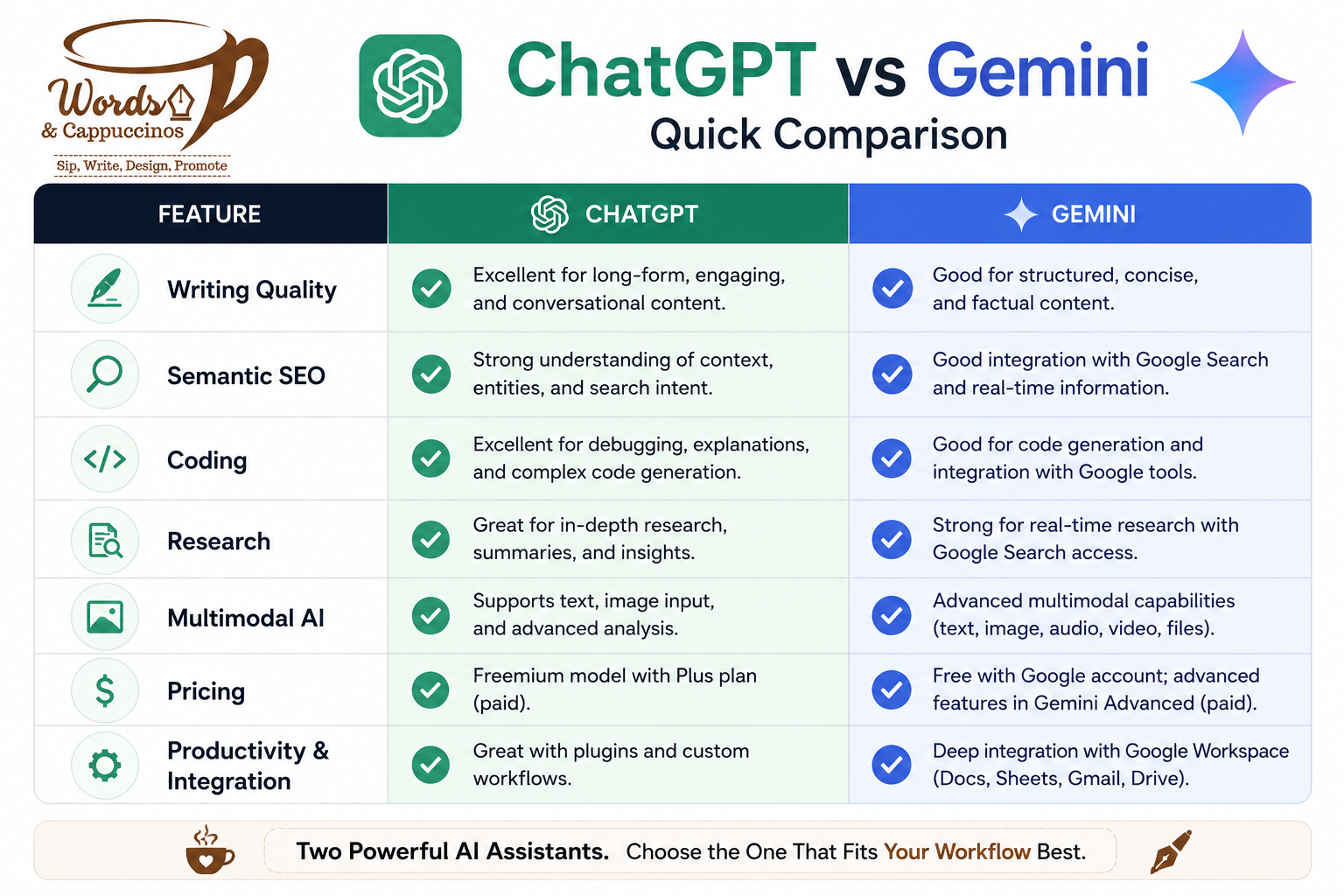 Although both AI assistants are powered by advanced Machine Learning systems and LLMs, their strengths differ considerably.
ChatGPT vs Gemini: Quick Comparison Table
| Feature | ChatGPT | Gemini |
| Developer | OpenAI | |
| Writing Style | Conversational and engaging | Concise and structured |
| Best For | SEO, writing, reasoning | Google productivity workflows |
| Semantic SEO | Excellent | Moderate |
| GEO & AEO | Strong optimisation capabilities | Good for summaries |
| Coding | Strong debugging and explanations | Strong cloud integration |
| Multimodal AI | Advanced | Native multimodal architecture |
| Real-Time Information | Available with tools | Native Google Search integration |
| Productivity | Flexible AI workflows | Workspace-focused collaboration |
| Context Window | Large | Extremely large |
ChatGPT vs Gemini for SEO and Content Writing
SEO content creation is one of the biggest use cases for AI assistants today. Businesses increasingly rely on AI-generated content to improve organic visibility, topical authority, and audience engagement.
However, not all AI-generated content performs equally well for SEO.
ChatGPT for SEO Content Writing
ChatGPT performs exceptionally well for:
- Landing pages
- Topic clustering
- Semantic SEO
- AI content optimisation
- GEO and AEO strategies
Its biggest advantage is its conversational writing style. ChatGPT naturally incorporates semantic entities, contextual relationships, and Search Intent into the content, which helps improve visibility in AI search engines and conversational search systems.
For example, when writing about AI assistants, ChatGPT can naturally include related concepts such as:
- Generative AI
- Large Language Models
- Prompt Engineering
- AI workflows
- Conversational AI
- Machine Learning
- AI productivity tools
This strengthens topical relevance and Semantic SEO performance.
Another major advantage is readability. ChatGPT produces outputs that feel closer to human-written content, which helps improve engagement and user experience.
Gemini for Content Writing
Gemini is highly effective for structured and productivity-focused content generation. It performs well for:
- Internal documentation
- Technical summaries
- Meeting notes
- Workspace collaboration
- Google Docs workflows
Its outputs are generally more concise and factual compared to ChatGPT. Businesses already operating heavily inside Google Workspace may find Gemini more efficient for operational workflows.
However, for emotionally engaging storytelling, long-form blogging, and conversational SEO content, ChatGPT often performs better because of its contextual depth and natural language flow.
ChatGPT vs Gemini for GEO and AEO
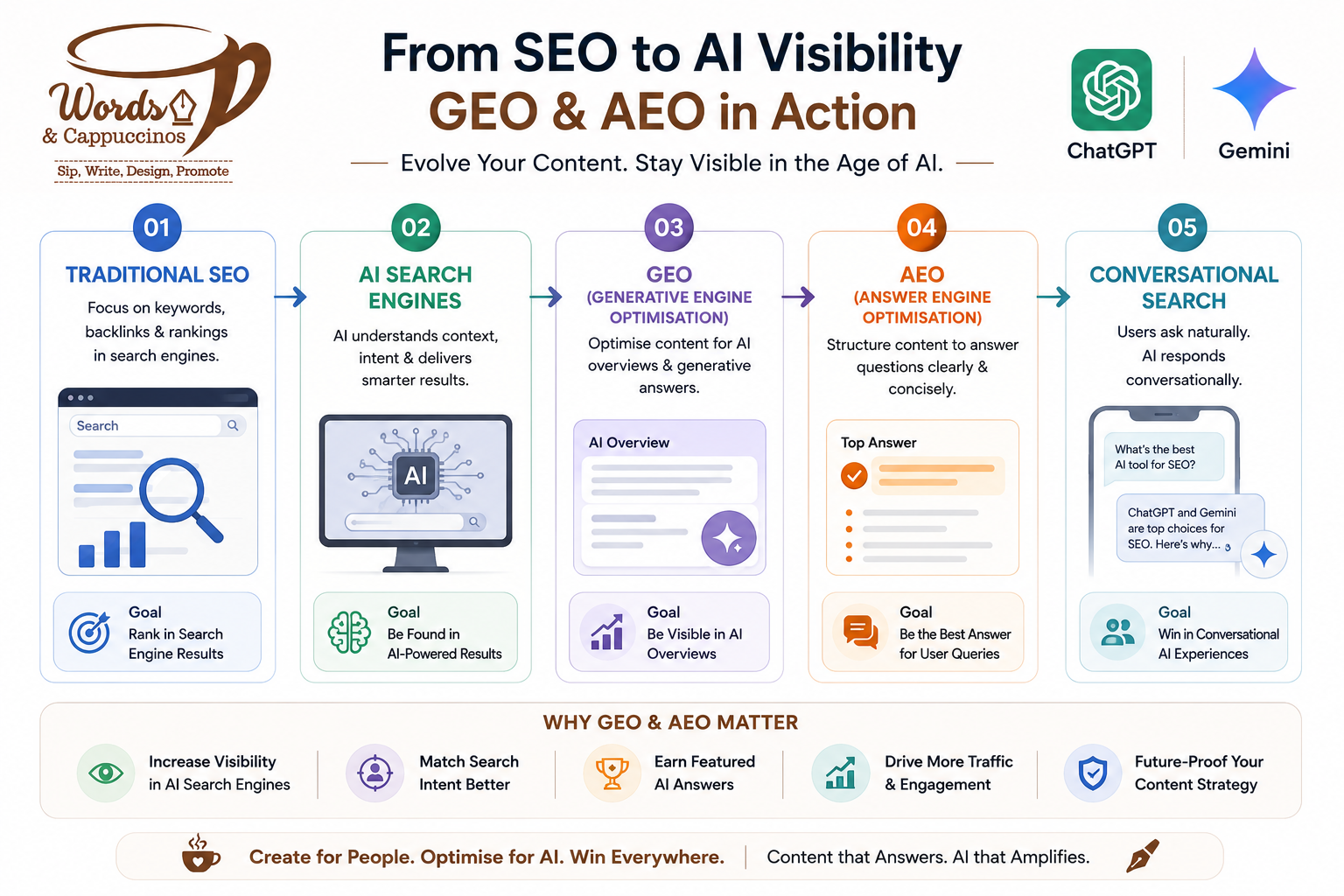 Search engines are evolving rapidly because of conversational AI and AI-generated search experiences.
Traditional SEO alone is no longer enough.
Businesses must now optimise content for:
- GEO (Generative Engine Optimisation)
- AEO (Answer Engine Optimisation)
- Conversational search
- AI search engines
- Voice search
Why ChatGPT Is Better for GEO and AEO
ChatGPT excels at creating:
- Structured answers
- Conversational responses
- Entity-rich content
- FAQ sections
- Contextual explanations
- Search Intent-focused content
These features improve visibility inside AI-generated search summaries and conversational AI systems.
For example, Answer Engine Optimisation works best when content includes direct, concise, and contextual answers to user queries. ChatGPT naturally generates this style of content effectively.
This makes ChatGPT especially valuable for businesses focused on:
- Organic traffic
- Featured snippets
- AI Overviews
- Voice search visibility
- Conversational AI optimisation
Why Semantic SEO Matters in 2026
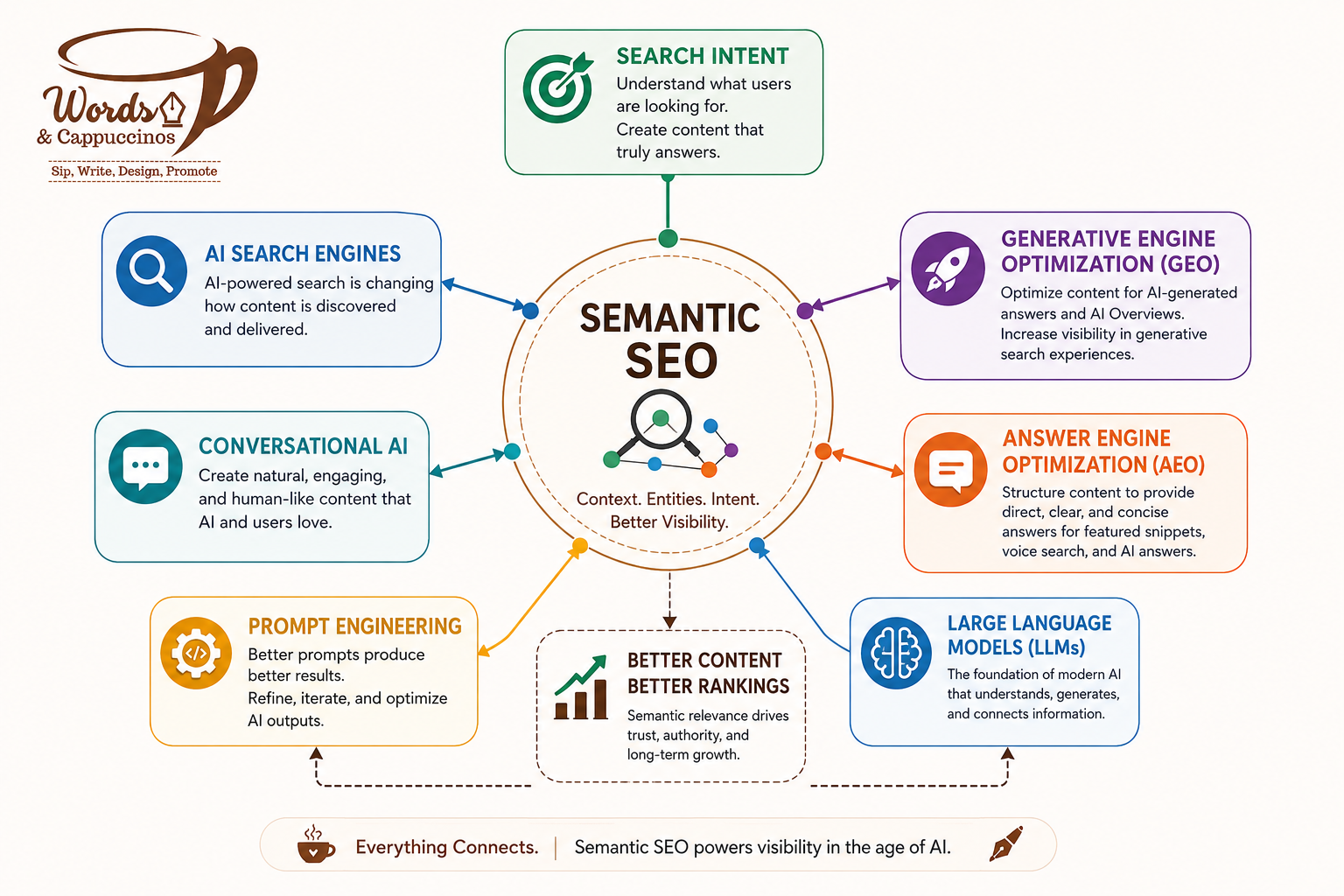 Modern search engines use Machine Learning and Natural Language Processing to understand topics contextually instead of relying only on keywords.
Semantic SEO focuses on building topical depth using related concepts and entities.
For example, a blog comparing ChatGPT vs Gemini should naturally include semantic entities such as:
| Semantic Entity | Relevance |
| Generative AI | Core AI technology |
| Large Language Models | Foundation of AI assistants |
| Prompt Engineering | Improves AI outputs |
| Conversational AI | Important for AI search |
| AI workflows | Productivity and automation |
| Multimodal AI | Major differentiator |
| AI search engines | GEO optimisation |
| Search Intent | Essential for SEO |
| Machine Learning | Underlying AI technology |
Including these semantic concepts improves contextual relevance and strengthens visibility in AI search systems.
ChatGPT vs Gemini for Coding
Developers increasingly use AI assistants for programming, debugging, and workflow automation.
Both ChatGPT and Gemini support coding tasks, but their strengths differ.
ChatGPT for Coding
ChatGPT performs exceptionally well for:
- Debugging code
- Explaining programming logic
- Writing scripts
- API integration support
- Learning programming languages
- Software architecture discussions
Its conversational explanations make it easier for beginners and advanced developers alike to understand coding concepts clearly.
Many developers prefer ChatGPT because it provides step-by-step reasoning rather than just raw code snippets.
Gemini for Coding
Gemini performs strongly in:
- Google Cloud workflows
- Vertex AI integration
- Large-context coding tasks
- Technical documentation
- Real-time references
Businesses already working within Google Cloud environments may find Gemini more operationally efficient.
Its large context window also helps when analysing large documents or codebases.
ChatGPT vs Gemini for Research
AI assistants are increasingly replacing traditional search behaviour.
Instead of browsing multiple websites manually, users now rely on conversational AI systems for research and summarisation.
ChatGPT for Deep Research
ChatGPT is stronger for:
- Long-form analysis
- Strategic thinking
- Educational explanations
- Research synthesis
- Comparative analysis
It organises information clearly and explains concepts in a more conversational and accessible manner. This makes it highly useful for marketers, agencies, researchers, consultants, and educators.
Gemini for Real-Time Information
Gemini benefits from Google Search integration, which helps it access current information quickly.
This makes Gemini particularly useful for:
- Trend analysis
- Live information
- Real-time research
- Quick summaries
Businesses requiring updated data and productivity-focused workflows may prefer Gemini for research-related tasks.
ChatGPT vs Gemini for Multimodal AI
Multimodal AI refers to systems capable of processing text, images, audio, video, and documents together.
ChatGPT and Multimodal AI
ChatGPT supports:
- Image interpretation
- Document analysis
- Visual understanding
- Creative image generation
- Conversational interactions
Its multimodal AI features are highly useful for content marketing, visual ideation, and AI-assisted communication workflows.
Gemini and Multimodal AI
Gemini was designed with multimodal AI as a core capability. It performs strongly for:
- Visual reasoning
- Large-context processing
- Image analysis
- Workspace collaboration
This makes Gemini particularly effective for enterprise productivity environments.
ChatGPT vs Gemini Pricing Comparison
| Plan | ChatGPT Pricing | Gemini Pricing |
| Free Plan | Available | Available |
| Entry-Level Paid Plan | ₹399/month | ₹399/month |
| Mid-Tier Plan | ₹1,999/month | ₹1,950/month |
| Enterprise Plans | Custom pricing | Custom pricing |
| Best For | Content creators and marketers | Google Workspace users |
Limitations of ChatGPT and Gemini
Despite their strengths, both AI assistants have limitations.
1. AI Hallucinations
Both ChatGPT and Gemini can occasionally generate incorrect information confidently. This issue is known as AI hallucination.
Businesses should always fact-check AI-generated outputs before publishing or making decisions.
2. Bias in Responses
AI systems are trained on massive public datasets that may contain social or historical biases.
Human review remains essential to ensure ethical and accurate communication.
3. Privacy Concerns
Businesses handling confidential information should carefully review enterprise privacy controls and compliance policies before integrating AI assistants into sensitive workflows.
Which AI Assistant Should You Choose?
| Choose ChatGPT If You Need | Choose Gemini If You Need |
| SEO content writing | Google Workspace integration |
| Semantic SEO optimisation | Productivity workflows |
| GEO and AEO content | Real-time information |
| Conversational AI content | Team collaboration |
| Prompt Engineering | Google Cloud integration |
| Long-form blogging | Large-context workflows |
Future of AI Assistants in 2026 and Beyond
The future of AI assistants will be shaped by:
- More advanced Machine Learning
- Better reasoning capabilities
- Hyper-personalisation
- Autonomous AI workflows
- Stronger multimodal AI systems
Businesses will increasingly rely on AI productivity tools for:
- Content creation
- Workflow automation
- Conversational search
- AI-generated research
- Decision support systems
The gap between human workflows and AI systems will continue to narrow rapidly.
Conclusion
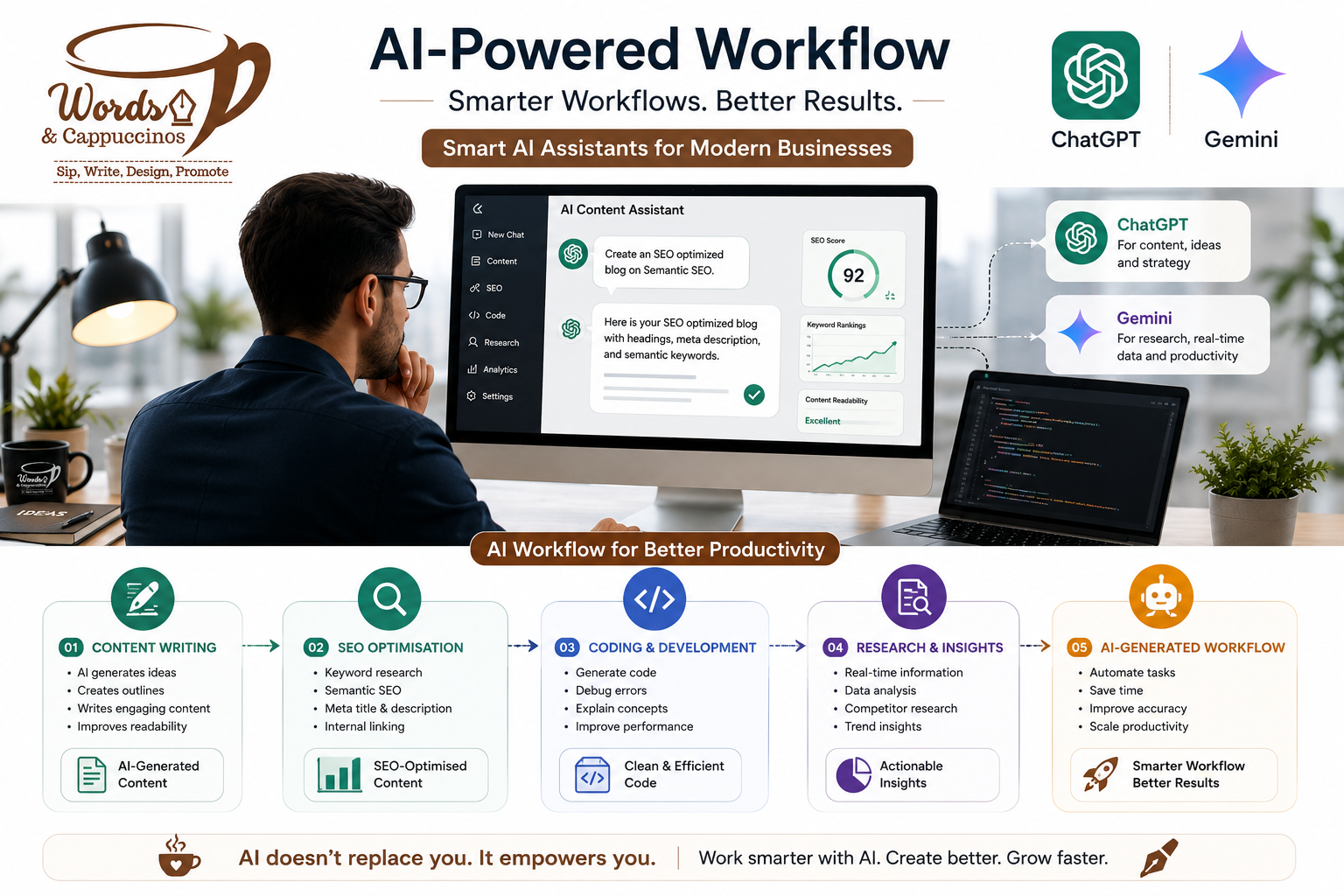 The ChatGPT vs Gemini debate is not about identifying a single universal winner. Both AI assistants are powerful, but they are designed for different workflows, business environments, and content strategies.
For businesses focused on:
- SEO and Semantic SEO
- GEO and AEO optimisation
- AI-generated content
- Conversational AI
- Long-form blogging
- Content marketing
- Prompt Engineering
- Search Intent optimisation
ChatGPT often provides stronger contextual writing, deeper reasoning, and more natural conversational outputs.
On the other hand, businesses deeply integrated into the Google ecosystem may prefer Gemini because of its seamless Google Workspace integration, multimodal AI capabilities, and real-time information retrieval.
However, despite the rapid rise of Generative AI and AI productivity tools, human expertise still plays a critical role in creating meaningful and high-performing content. AI can accelerate workflows, but strategic thinking, emotional intelligence, creativity, and brand voice still require human direction.
At Words And Cappuccinos, we believe the future of digital growth lies in combining:
- Human creativity
- Semantic SEO
- AI workflows
- Conversational AI optimisation
- GEO and AEO strategies
- Search Intent analysis
- High-quality content marketing
to create sustainable online visibility and stronger audience engagement.
As AI search engines continue evolving, businesses that balance AI efficiency with human-led content strategy will be better positioned to build authority, trust, and long-term organic growth in 2026 and beyond.
Frequently Asked Questions (FAQs)
1. Which AI assistant is better for SEO?
ChatGPT is generally better for SEO because it creates more conversational, contextually rich, and semantically optimised content that aligns with Search Intent and AI search engine requirements.
2. What is GEO in SEO?
GEO stands for Generative Engine Optimisation. It focuses on optimising content for AI-generated search experiences and conversational AI systems.
3. What is AEO?
AEO stands for Answer Engine Optimisation. It helps businesses optimise content for direct answers, voice search, and featured snippets.
4. Which AI tool is better for coding?
ChatGPT is often preferred for debugging, code explanations, and learning support, while Gemini performs strongly for Google Cloud integration and large-context coding tasks.
5. What are Large Language Models?
Large Language Models are advanced AI systems trained on massive datasets to understand and generate human-like language. Both ChatGPT and Gemini are powered by LLMs.
6. Why is Semantic SEO important in 2026?
Semantic SEO helps search engines understand contextual relationships between topics and entities, improving visibility in AI search engines and conversational search experiences.
7. Can AI-generated content rank on Google?
Yes. AI-generated content can rank well if it is helpful, accurate, user-focused, and aligned with Search Intent and Semantic SEO principles.
8. What is Prompt Engineering?
Prompt Engineering is the process of creating effective AI prompts to improve output quality, relevance, and contextual accuracy.


Words And Cappuccinos
Words And Cappuccinos is a trusted full-service digital agency specializing in content, marketing, and design. Check out our insightful articles, practical tips, and industry trends to grow your brand smartly.