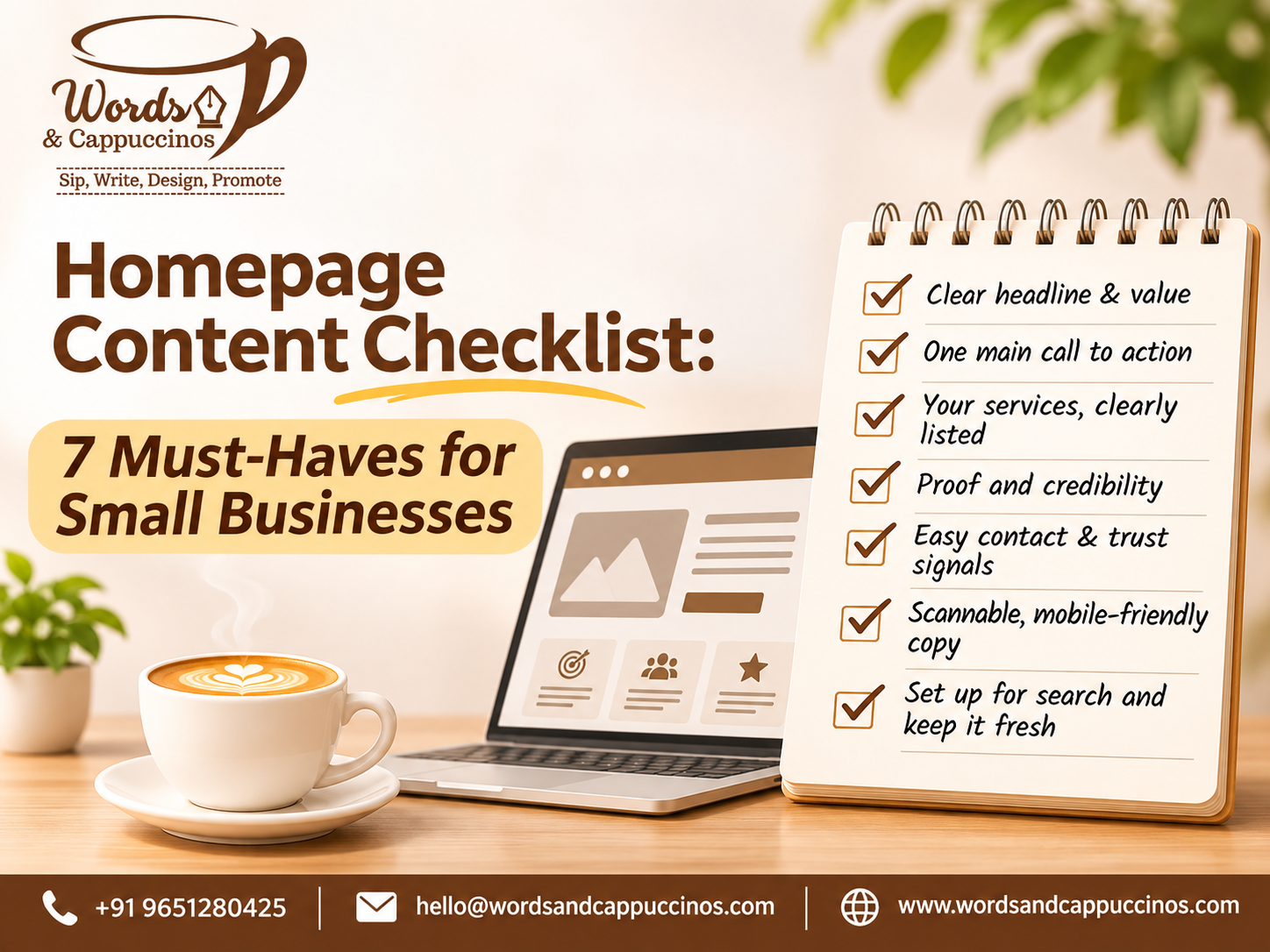
Homepage Content Checklist: 7 Must-Haves for Small Businesses
Most small business homepages fail for a simple reason: a first-time visitor cannot tell, within a few seconds, what you do, whether you are right for them and what to do next. This homepage content checklist gives you seven things every homepage needs, with a before-and-after example for each.
Use it as a website content checklist when you build a new site or as a quick audit of the one you have. It covers what to put on a homepage in the order visitors need it. If you want the full process for writing every page, read our website content writing guide.
What to put on a homepage: the 7-point checklist
The examples below are illustrative, written for made-up businesses so you can see the pattern. Replace anything in square brackets with your own details.
1. Lead with a clear headline and one-line value statement
Visitors decide quickly whether a site is for them. Your headline should say what you do, who it is for and the result they get. Skip slogans and “Welcome to…”, which tell them nothing.
Check: The headline names your service and your customer, and one supporting sentence states the benefit.
Before: “Welcome to Greenleaf Solutions, a leading provider of quality services.”
After: “Weekly home cleaning in Austin, with the same trusted cleaner every visit.”
2. Give visitors one main call to action
Too many choices stall people. Pick one primary action, place it where visitors can see it without scrolling, and repeat it further down the page. Use a label that says what happens next.
Check: One main button above the fold, repeated after your services and proof sections.
Before: Four buttons on one screen: “Submit”, “Learn more”, “Click here” and “Read more”.
After: One main button, “Get a free quote”, with a quieter “Call us” link beside it.
3. Show what you offer in your customers’ words
List your services or products in the plain language people use when they search, and link each one to its own page. Visitors should be able to confirm in seconds that you offer what they need.
Check: Three to six services or products, each with a short benefit-led line and a link.
Before: “We provide a full range of integrated financial solutions.”
After: “Bookkeeping, tax returns, payroll and year-end accounts for small businesses.”, with each service linking to its own page.
4. Add proof near the top
Claims are easy to make, so show evidence: reviews, results, client logos, years in business or certifications. Specific proof beats general praise. Get permission before using a customer’s words.
Check: At least one real review or result, with a number or a name, within the first two screens.
Before: “Our customers love us.”
After: “[4.8] stars from [212] Google reviews. ‘The boiler was fixed the same day and the price matched the quote.’ [Customer name, town]”
5. Make it easy to contact and trust you
People ready to act look for a phone number, an address and opening hours. A short note about who you are, ideally with a real photo, helps visitors feel they are dealing with real people.
Check: Phone or WhatsApp in the header, full contact details and hours in the footer, and a short “who we are” line.
Before: Contact details on a separate page, with only “Get in touch” in the footer.
After: Header: phone number and WhatsApp button. Footer: address, opening hours, “Family-run since [year]” and a photo of the team.
6. Use scannable homepage copywriting that works on mobile
Visitors skim, and many are on a phone. Good homepage copywriting uses short sections, headings that say something useful, benefit-led sentences and bullets instead of long paragraphs. Always check how each section looks on a small screen. If your site’s layout makes that hard, our custom website development team can help.
Check: No paragraph longer than three or four lines, and every section has a heading that tells the reader what they will get.
Before: “Founded in 2009, we are a family-owned company with a passion for excellence and a commitment to customer satisfaction across a wide range of home improvement projects…”
After: Heading: “Kitchen and bathroom remodels, finished on time.” Then two bullets: “Fixed quotes, no surprise extras” and “One project manager from start to finish”.
7. Set the page up to be found, and keep it fresh
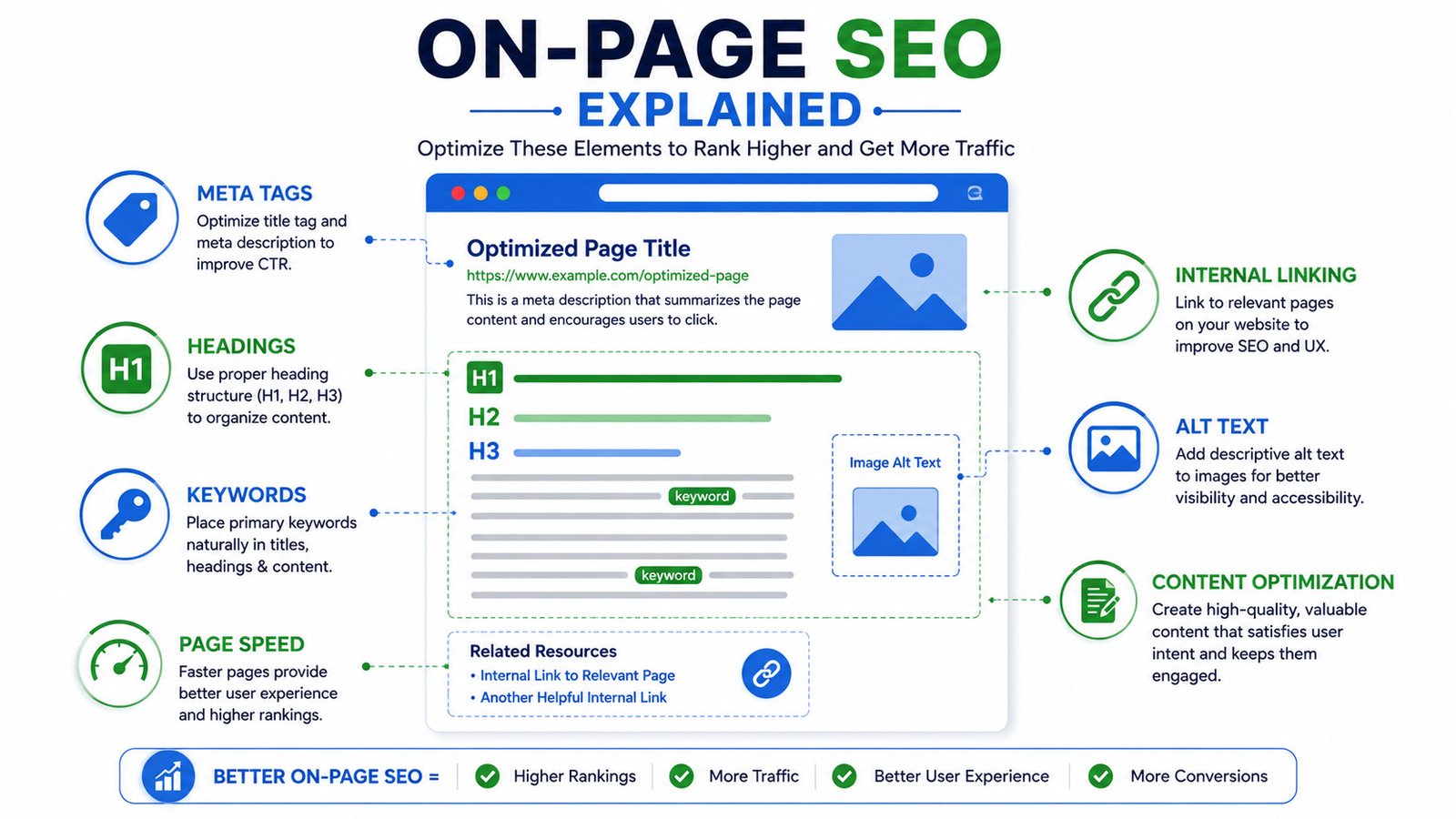
Your homepage is often your most visited page, so the basics matter: a unique title tag, a short meta description, headings that describe each section and links with descriptive text to your key pages. Google’s SEO starter guide recommends titles that are unique, clear and concise, and link text that tells readers and search engines what the next page is about. Review the page every quarter and whenever your services, prices or offer change.
Check: A title that includes what you do and where, links that describe their destination, and a date in your calendar to review the page.
Before: Title tag: “Home”. Link text: “click here”.
After: Title tag: “Wedding Photographer in Bristol | Sam Carter Photography”. Link text: “See wedding packages”.
Common homepage mistakes to avoid
- Vague taglines that could belong to any business in your industry.
- Trying to say everything at once. Focus the top of the page on a few core tasks.
- Relying on generic stock photos instead of real photos of your work, team or premises.
- Leaving out-of-date offers, prices or dead links on the page.
Score your homepage in five minutes
Use this homepage content checklist as a scorecard: give your homepage one point for each of the seven items above. Then try the five-second test: show the page to someone who does not know your business for five seconds, then ask what you do, who it is for and what they would click next.
- 6–7 points: strong. Fine-tune the wording and keep the proof fresh.
- 3–5 points: good bones, but visitors are missing something. Fix items 1 and 2 first.
- 0–2 points: rewrite the top of the page before you change anything else.
Frequently asked questions
How long should homepage content be?
There is no fixed length. It should be long enough to answer a first-time visitor’s questions and short enough to scan. If a section does not help someone decide, cut it.
What should go above the fold?
Your headline and value statement, your main call to action and, if you can, a hint of proof such as a review rating. That is the part of the page visible without scrolling.
How often should I update my homepage?
Review it every quarter, and any time your services, prices or offer change. Add new reviews and results as you collect them.
Final thoughts
Good small business website content does not need to be long or clever. It needs to be clear, specific and easy to act on. Work through the seven points, fix the biggest gap first, and test again.
Not sure how your homepage scores? Send us the word WEBSITE on WhatsApp (+91 9651280425) for a free homepage review. If you would rather have a writer do the work, see our website content writing services.


Ankita Gupta
Our Founder
Ankita founded Words And Cappuccinos to prove that good writing is a business asset, not a line item. She leads strategy across every account.