WordPress vs Custom Website Development in India: Which Is Right for Your Business? (2026)
WordPress is the right choice for most Indian businesses such as small and medium companies, service providers, startups, bloggers, and brands that need a professional website quickly and affordably. Custom website development is right when your project requires functionality that no existing platform can deliver, or when performance, security, and long-term scalability are non-negotiable and budget is not the primary constraint. For most Indian SMEs, WordPress with a professional development team delivers 90% of what custom development offers at 30-40% of the cost.
This is one of the most common and most consequential decisions Indian businesses make when planning a website. Get it right and you have a platform that serves your business reliably for years. Get it wrong and you either overspend on complexity your business does not need, or you hit a wall twelve months later when your WordPress site cannot do what your growing business requires.
The decision is not really about WordPress versus custom development. It is about matching the right technical approach to your specific business goals, budget, timeline, and growth trajectory. This guide gives you the framework to make that decision with confidence including a section on the hybrid approaches that most agencies in India never mention.
If you have not yet settled on a budget, read our complete 2026 website development pricing guide for India before continuing as cost context will make the comparison below significantly more useful.
What Is WordPress and What Is Custom Website Development?
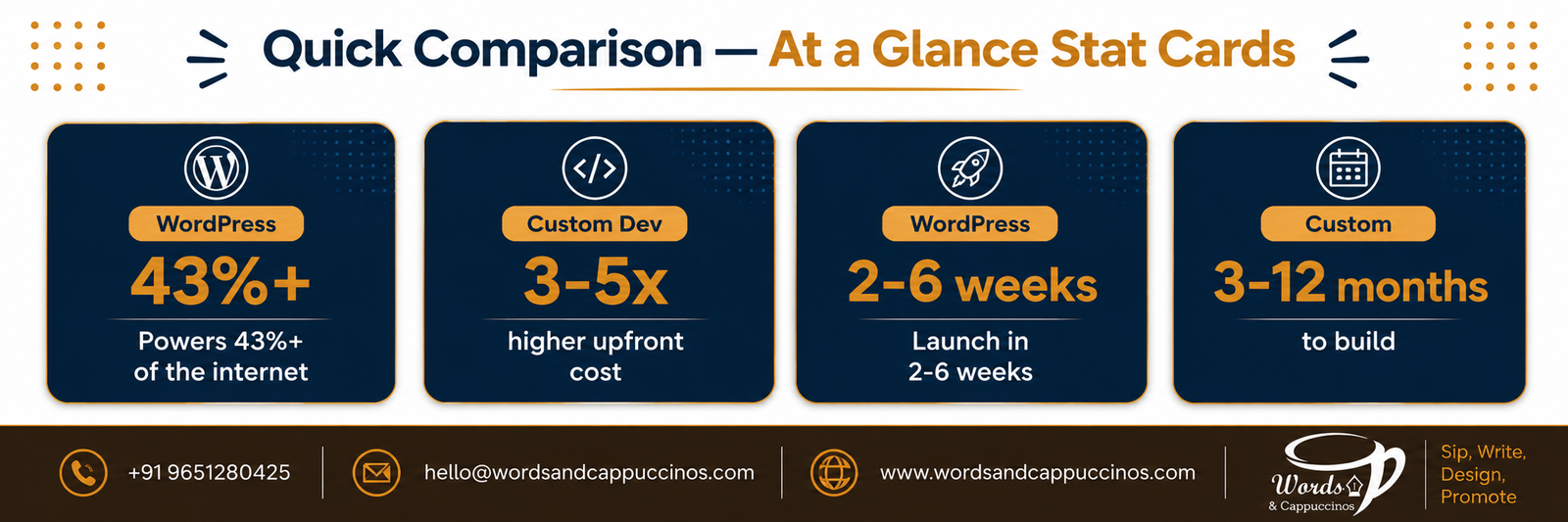 WordPress: An open-source content management system (CMS) that powers over 43% of all websites on the internet. It provides a pre-built framework, thousands of themes for visual design, and tens of thousands of plugins for additional functionality. You build on top of an existing foundation rather than from scratch.
Custom Website Development: Building a website from the ground up using programming languages and frameworks such as PHP/Laravel, Python/Django, Node.js, or React/Next.js. No pre-built foundation as every feature is engineered specifically for your requirements.
The fundamental difference is build versus configure. WordPress involves selecting and configuring an existing system. Custom development involves building a system designed precisely for your needs. Both produce functioning websites. The right choice depends entirely on what you need that website to do.
The Full Comparison: WordPress vs Custom Website Development
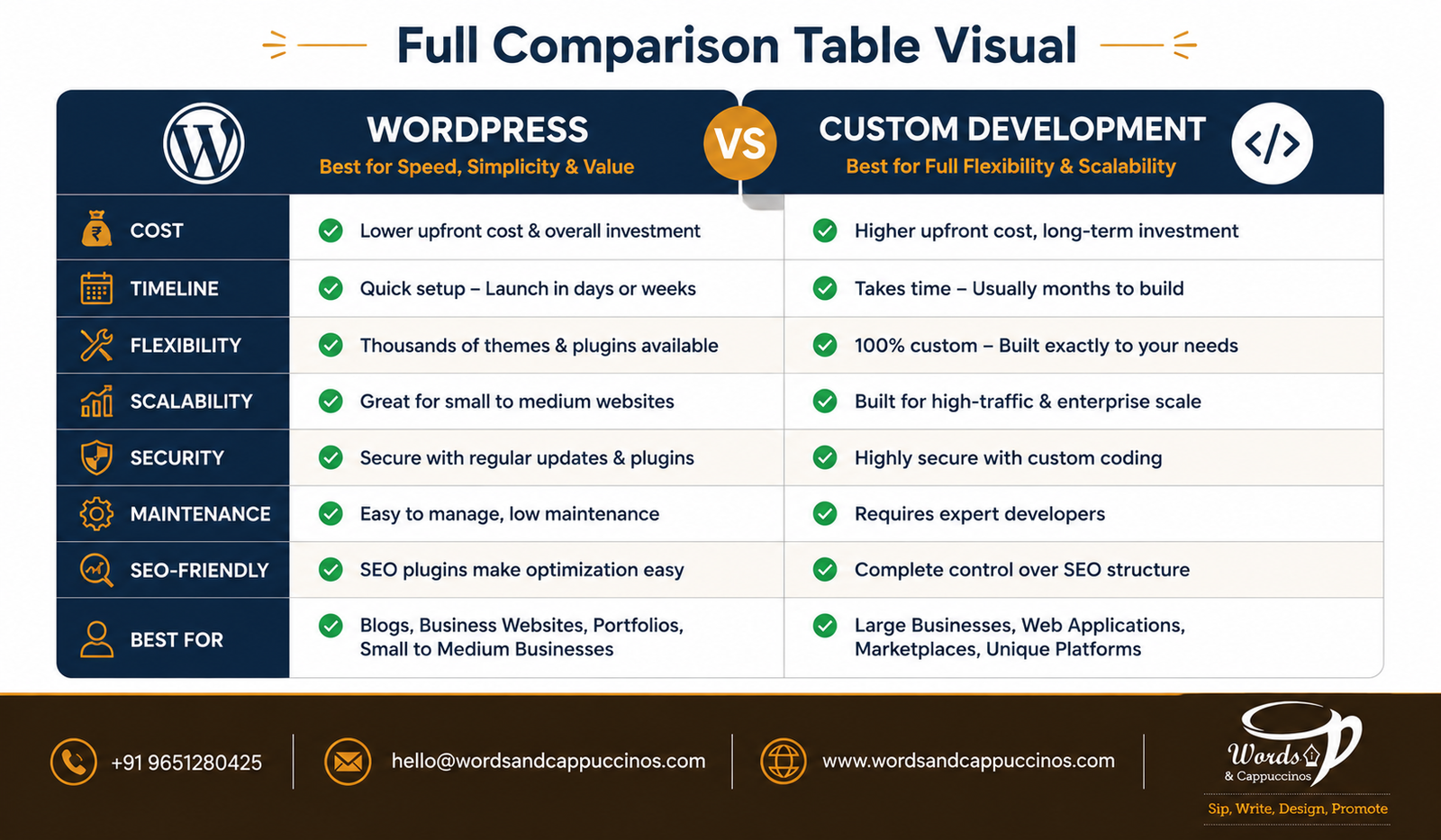
| Factor | WordPress | Custom Development |
|---|---|---|
| Upfront cost (India) | ₹30,000 – ₹3,00,000 | ₹1,50,000 – ₹20,00,000+ |
| Time to launch | 2 – 8 weeks | 3 – 12 months |
| Ease of content management | High — non-technical users can manage content | Low to medium — depends on what admin panel is built |
| Design flexibility | Medium — themes limit some decisions | Complete — every pixel is intentional |
| Functionality flexibility | Medium — plugins cover most needs; complex custom logic is harder | Complete — anything can be built |
| Performance ceiling | 85–92 PageSpeed (optimised setup) | 95–100 PageSpeed (well-built custom site) |
| SEO capability | High — Rank Math, Yoast, strong ecosystem | High — but requires deliberate engineering effort |
| Security | Medium — plugins create vulnerability surface | High — no third-party code unless explicitly added |
| Scalability | Good for most businesses; limits appear at enterprise scale | Unlimited — scales to millions of users if architected correctly |
| Developer dependency | Low for content; medium for structural changes | High — all changes require developer involvement |
| Ongoing monthly cost | ₹2,000 – ₹8,000 (maintenance package) | ₹15,000 – ₹50,000+ (developer retainer) |
| Best for | SMEs, startups, service businesses, blogs, e-commerce (WooCommerce/Shopify) | SaaS platforms, marketplaces, enterprise portals, apps with unique functionality |
Cost Comparison: WordPress vs Custom Development for Indian Businesses
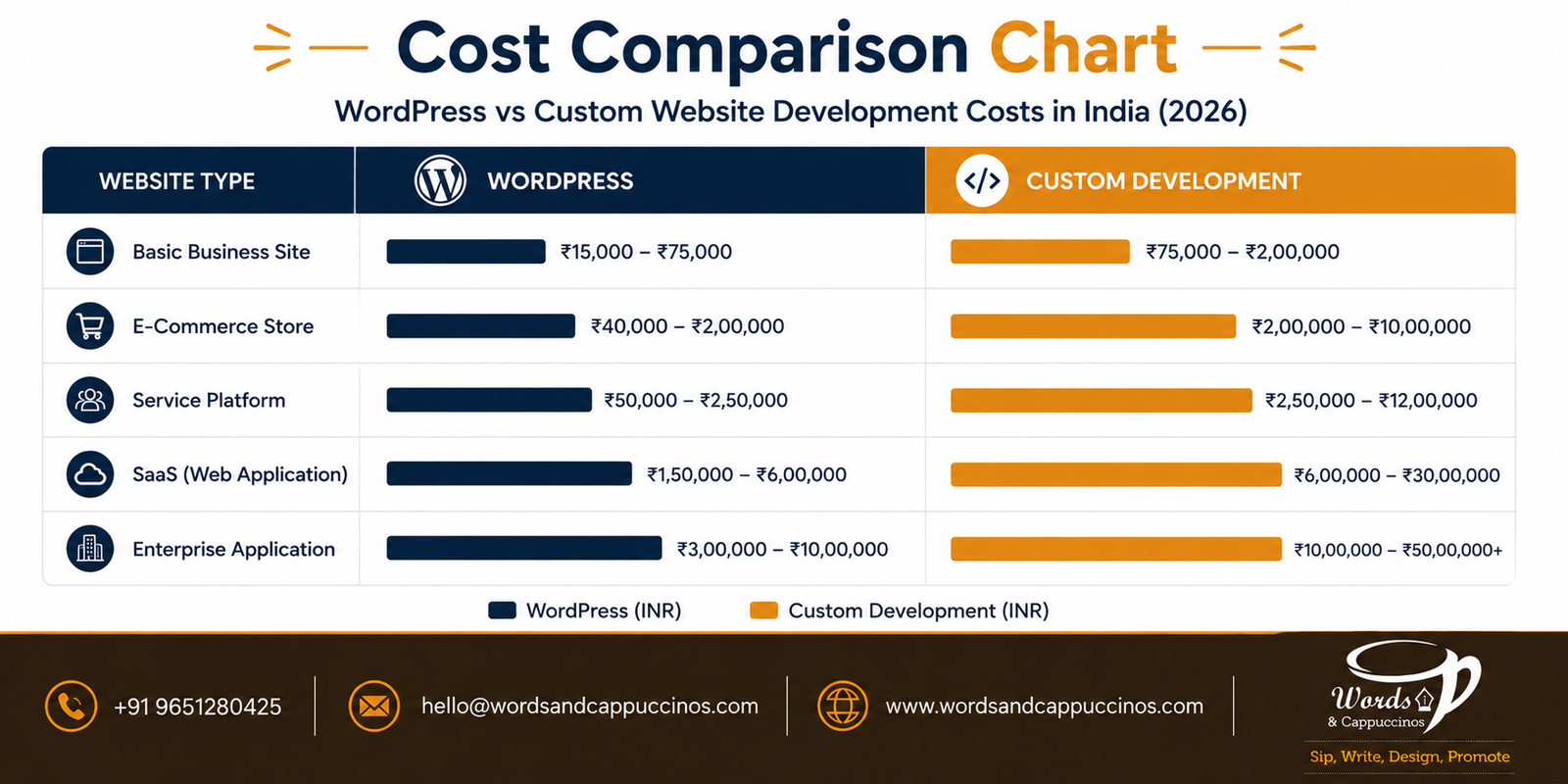 Cost is the most discussed factor in this decision and the one most frequently misrepresented. Here is what Indian businesses actually pay across the most common project types:
| Project Type | WordPress Cost (Agency) | Custom Development Cost | Cost Multiple |
|---|---|---|---|
| Basic business website (5-10 pages) | ₹30,000 – ₹1,00,000 | ₹1,50,000 – ₹5,00,000 | 3x – 5x |
| E-commerce store (up to 500 products) | ₹80,000 – ₹3,00,000 (WooCommerce) | ₹3,00,000 – ₹10,00,000 | 3x – 4x |
| Service platform with booking/portal | ₹1,00,000 – ₹4,00,000 | ₹5,00,000 – ₹15,00,000 | 4x – 5x |
| SaaS or marketplace | WordPress is generally not suitable | ₹8,00,000 – ₹50,00,000+ | — |
| Enterprise with integrations | ₹2,00,000 – ₹6,00,000 | ₹10,00,000 – ₹1,00,00,000+ | 5x – 10x+ |
The cost multiple narrows as project complexity increases because complex WordPress projects require significant custom development within the platform anyway. For highly complex requirements, the cost difference between a well-built WordPress site and a well-built custom site is smaller than most people expect.
The cost multiple is also not the right metric to optimise for. The correct question is: which platform delivers better returns on this budget for this specific project? A ₹3,00,000 WordPress e-commerce site that converts at 3% outperforms a ₹10,00,000 custom site that converts at 1.5%.
For a complete breakdown of what drives website development costs in India, including hidden costs most agencies do not disclose, see our website development India pricing guide 2026.
SEO: Which Platform Ranks Better on Google in India?
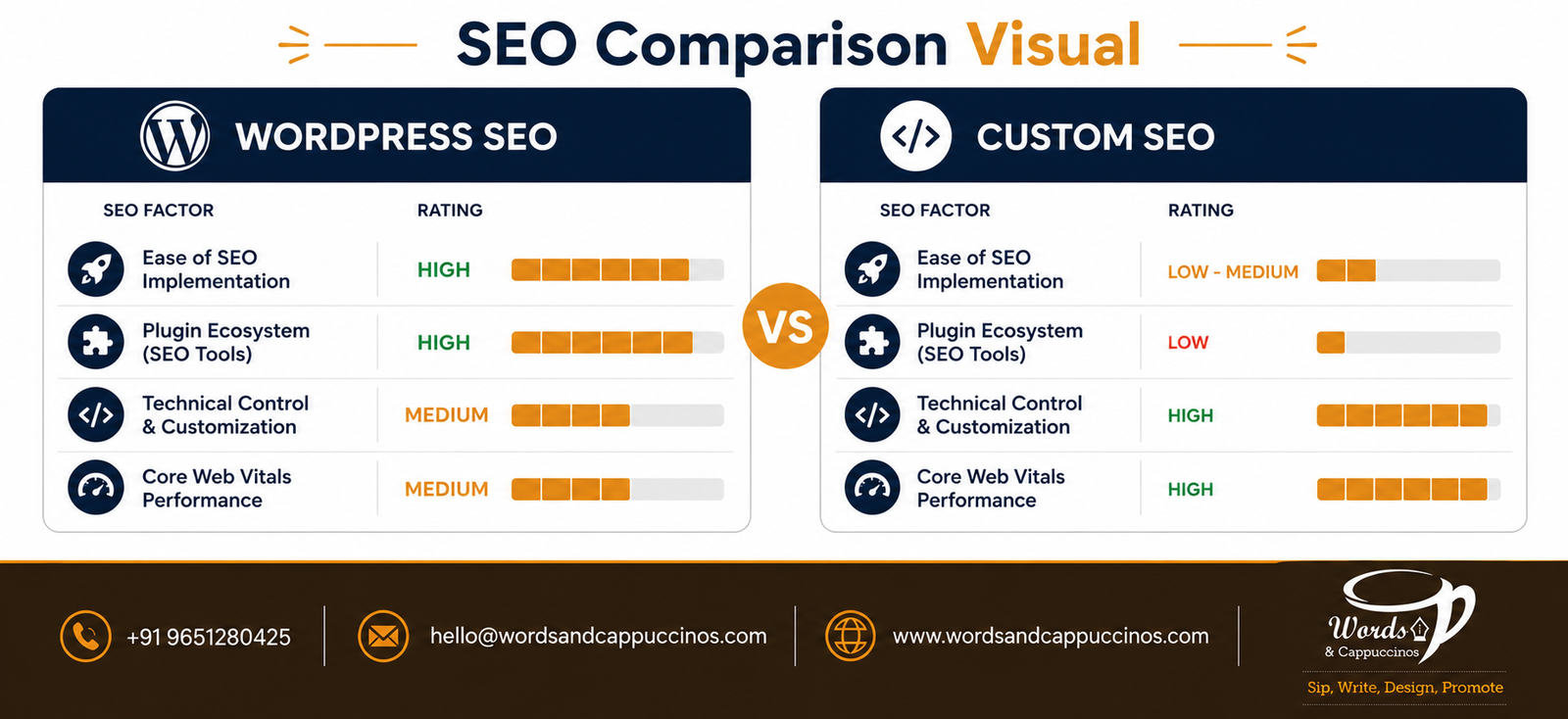
This is the question Indian business owners get most wrong. The common assumption is that custom websites are better for SEO. The reality is more nuanced and for most Indian businesses, WordPress is the stronger SEO choice.
WordPress SEO strengths
- Plugin ecosystem: Rank Math, the most widely used SEO plugin in India, and Yoast SEO give WordPress sites out-of-the-box access to meta optimisation, schema markup, XML sitemaps, canonical tags, breadcrumb trails, and on-page SEO scoring. Building equivalent functionality on a custom site requires deliberate engineering investment.
- Content management for ongoing publishing: Consistent blog publishing is one of the strongest organic growth signals available to Indian businesses. WordPress makes this frictionless as no developer is required to publish new content. Custom sites often create a bottleneck where publishing requires developer involvement, which means publishing happens less frequently.
- Community and support: WordPress SEO has the largest knowledge base of any CMS. When Google updates its algorithm, the WordPress plugin ecosystem adapts within days. Custom sites require developers to manually implement equivalent changes.
- Integration with Indian SEO tools: Rank Math is built specifically for WordPress. Its integration with Google Search Console, schema builder, and keyword tracking works seamlessly out of the box.
Custom website SEO strengths
- Core Web Vitals ceiling: A well-built Next.js or React custom site will consistently achieve PageSpeed scores of 95-100 on mobile and desktop. Optimised WordPress sites typically achieve 85-92. For high-traffic e-commerce where every 100ms of load time affects conversion rates, this performance gap is commercially meaningful.
- Technical architecture control: Custom sites give developers complete control over URL structures, rendering strategies (server-side vs client-side), caching architecture, and code splitting. For very large sites with thousands of pages, this control enables SEO optimisations that are difficult to achieve in WordPress.
- Zero plugin bloat: Every WordPress plugin adds HTTP requests, JavaScript files, and database queries. A custom site loads only what it needs which is why custom sites tend to be faster by default, even before optimisation.
The honest conclusion: for the vast majority of Indian businesses targeting local and national search rankings through content marketing and on-page SEO, WordPress with Rank Math delivers results that are indistinguishable from a custom site in Google’s eyes. Custom development’s SEO advantage only becomes meaningful at scale — high-traffic e-commerce, large content platforms, or enterprise sites where technical performance differences translate into measurable revenue impact.
For businesses prioritising SEO as their primary growth channel, read our SEO services guide for Indian businesses alongside this comparison. Platform choice and SEO strategy are deeply connected.
Scalability: Which Platform Grows With Your Business?
Scalability concerns are the most common reason Indian businesses are steered toward custom development by agencies and the most frequently exaggerated.
WordPress scales effectively for the overwhelming majority of Indian business use cases. The platform powers major news publications, large e-commerce stores, and enterprise content platforms handling millions of monthly visitors. Scaling WordPress requires the right hosting infrastructure (VPS or cloud hosting, CDN, caching), a clean plugin architecture, and a developer who understands performance optimisation; none of which are inherent to the platform choice.
Where WordPress does hit genuine scalability limits:
- Complex, custom business logic that requires unique database architectures, for example, a marketplace where pricing logic involves dynamic calculations across thousands of vendor variables
- Real-time features — live chat systems, collaborative editing, real-time dashboards that require persistent connections WordPress’s request-response architecture does not handle efficiently
- Microservices architectures where different components of a platform need to scale independently
- SaaS products where the website is the product, not a marketing vehicle for the product
If your business is planning to build any of the above, custom development is the right answer. If your business is planning to grow its content output, expand its service offerings, add more pages, and increase its marketing and e-commerce footprint, WordPress scales to support that growth without requiring a platform migration.
Ease of Management: Who Can Update the Site After Launch?
This is the most underrated factor in the WordPress vs custom decision and the one that causes the most regret when it is evaluated after the site is built rather than before.
WordPress gives non-technical users direct control over their website content. A marketing manager, founder, or content writer can publish a new blog post, update a service page, change a team photo, add a product to the store, or adjust a call-to-action without contacting a developer. This independence has a direct commercial value; it means content is published faster, updates happen immediately, and the business does not pay developer rates for tasks that should not require developer involvement.
Custom websites, by design, are built for specific requirements. Adding a new page type, changing the layout of a section, or integrating a new tool requires a developer to write and deploy code. For businesses that publish frequently, update their services regularly, or run active content marketing programmes, this dependency is a significant ongoing cost and a bottleneck that slows the business down.
The exception is when a custom website is built with a well-designed admin panel essentially a custom CMS. Good custom development teams build administrative interfaces that give content managers the same editing flexibility as WordPress, applied to the custom architecture. This is the right approach for complex custom projects but it adds to the development cost and is not always included in standard custom development quotes.
WAC’s CMS development services cover both WordPress CMS implementation and custom admin panel development for bespoke websites so your team always has the editorial control they need, regardless of the underlying platform.
Ongoing Costs: WordPress vs Custom After Launch
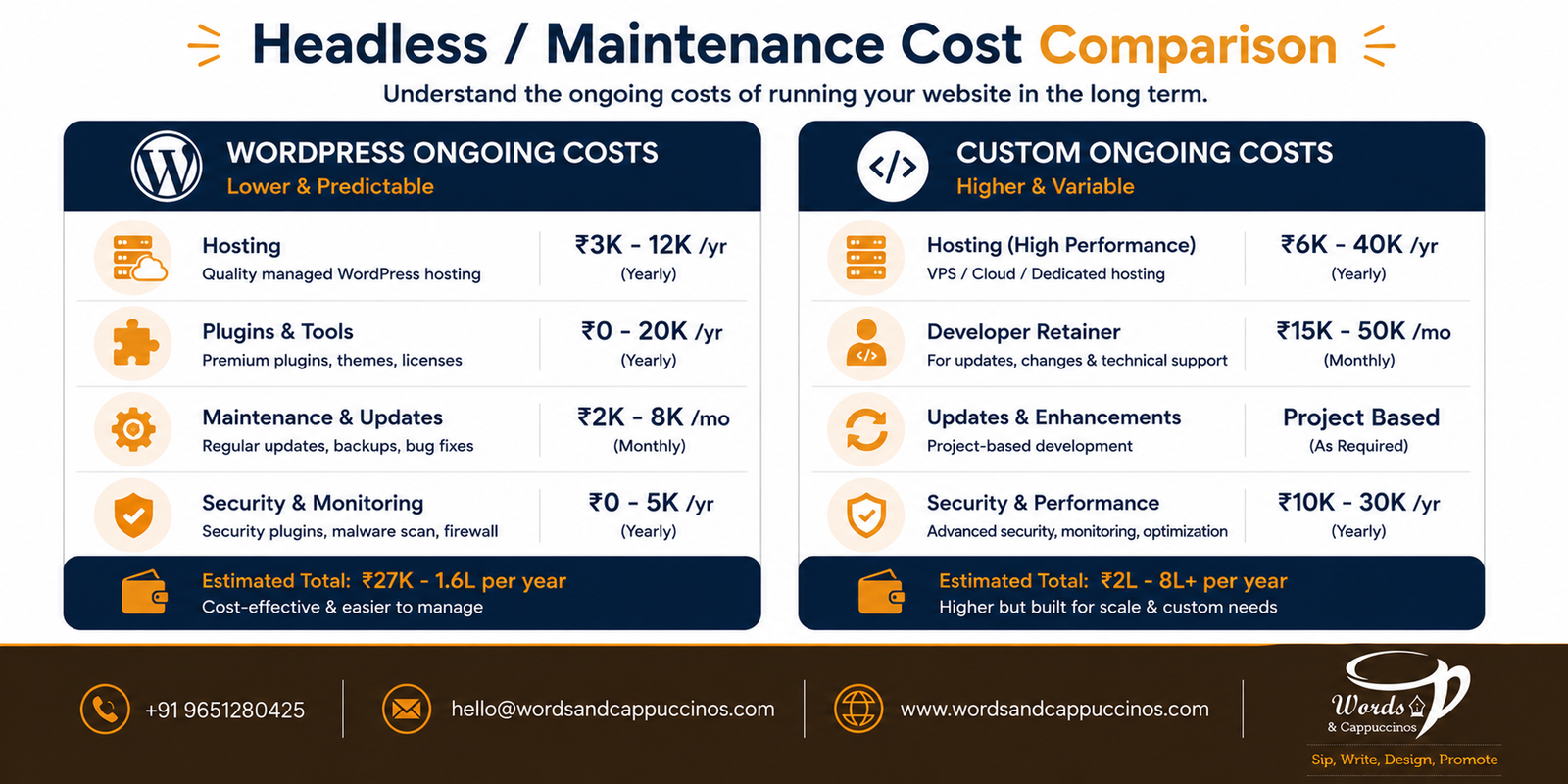 The total cost of a website is not the development invoice. It is the development cost plus everything you spend on the site over its operational life. This is where the WordPress vs custom cost comparison looks very different from the upfront numbers.
| Cost Item | WordPress (Annual) | Custom Development (Annual) |
|---|---|---|
| Hosting | ₹3,000 – ₹20,000 | ₹6,000 – ₹60,000 |
| Domain and SSL | ₹1,500 – ₹3,000 | ₹1,500 – ₹3,000 |
| Premium plugins/themes | ₹0 – ₹20,000 | Not applicable |
| Maintenance package | ₹24,000 – ₹96,000 (₹2K-8K/month) | — |
| Developer retainer | ₹0 for content; ₹15,000-50,000/month if structural changes | ₹15,000 – ₹60,000/month |
| Security monitoring | ₹0 (plugin-based) to ₹5,000 | ₹5,000 – ₹20,000 |
| Content updates | Self-managed (no cost) | Developer time required |
| Total annual estimate | ₹30,000 – ₹1,50,000 | ₹2,50,000 – ₹10,00,000+ |
The ongoing cost gap is significant. For most Indian businesses, the annual cost of maintaining a custom website exceeds the original WordPress development cost within 12 to 18 months. This does not make custom development the wrong choice, for complex products, the ongoing cost is justified by the capability. But it should be factored into the total cost of ownership, not evaluated solely as an upfront comparison.
For details on what professional website maintenance includes and costs, see our website maintenance services India guide.
The Hybrid Option: Headless WordPress
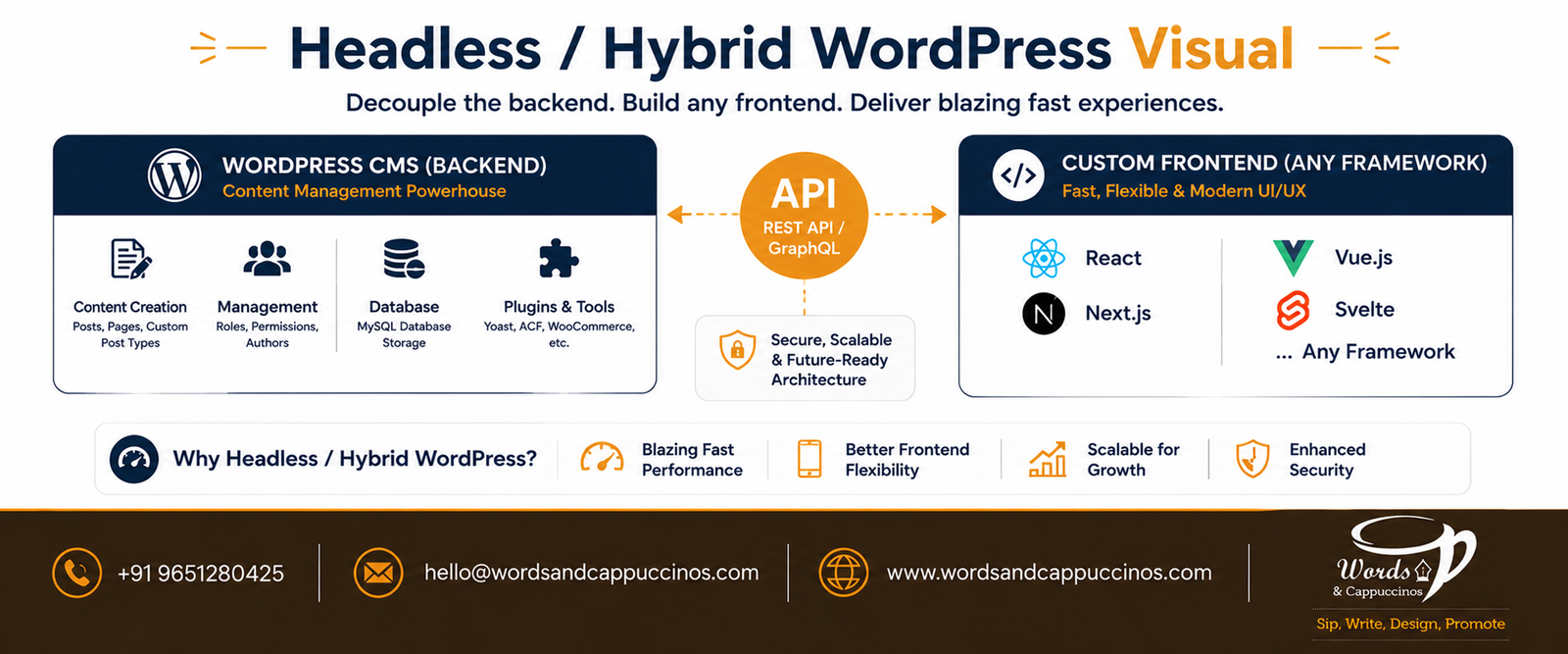 There is a third option that most agencies in India never mention i.e. headless WordPress. It resolves the central tension between WordPress and custom development by separating the content management layer from the front-end rendering layer.
In a headless WordPress setup, WordPress handles content management (editors use the familiar WordPress interface to publish and manage content), while a custom front-end built in Next.js or React handles the presentation layer. The two communicate via WordPress’s REST API. The result is a site with WordPress’s content management simplicity and custom development’s performance ceiling.
- Who it is right for: Businesses that need WordPress’s content management ease but custom-level performance — fast-growing D2C brands, content-heavy platforms, businesses with active SEO programmes who also need 95+ PageSpeed scores.
- Cost: ₹3,00,000 – ₹8,00,000 to build. Higher than standard WordPress, significantly lower than full custom for the same performance outcome.
- Complexity: Requires a development team experienced in both WordPress and modern JavaScript frameworks. Not all Indian agencies offer this; ask specifically if headless WordPress is on the table when you receive proposals.
Headless WordPress is worth evaluating if you find yourself wanting WordPress’s ease of management but being told your performance requirements make custom necessary. It is often the right answer to a question that was being framed as binary.
WAC’s custom website development services include both headless WordPress and full custom development options selected based on your specific functional and performance requirements.
Who Should Choose WordPress and Who Should Choose Custom Development?
 Choose WordPress when:
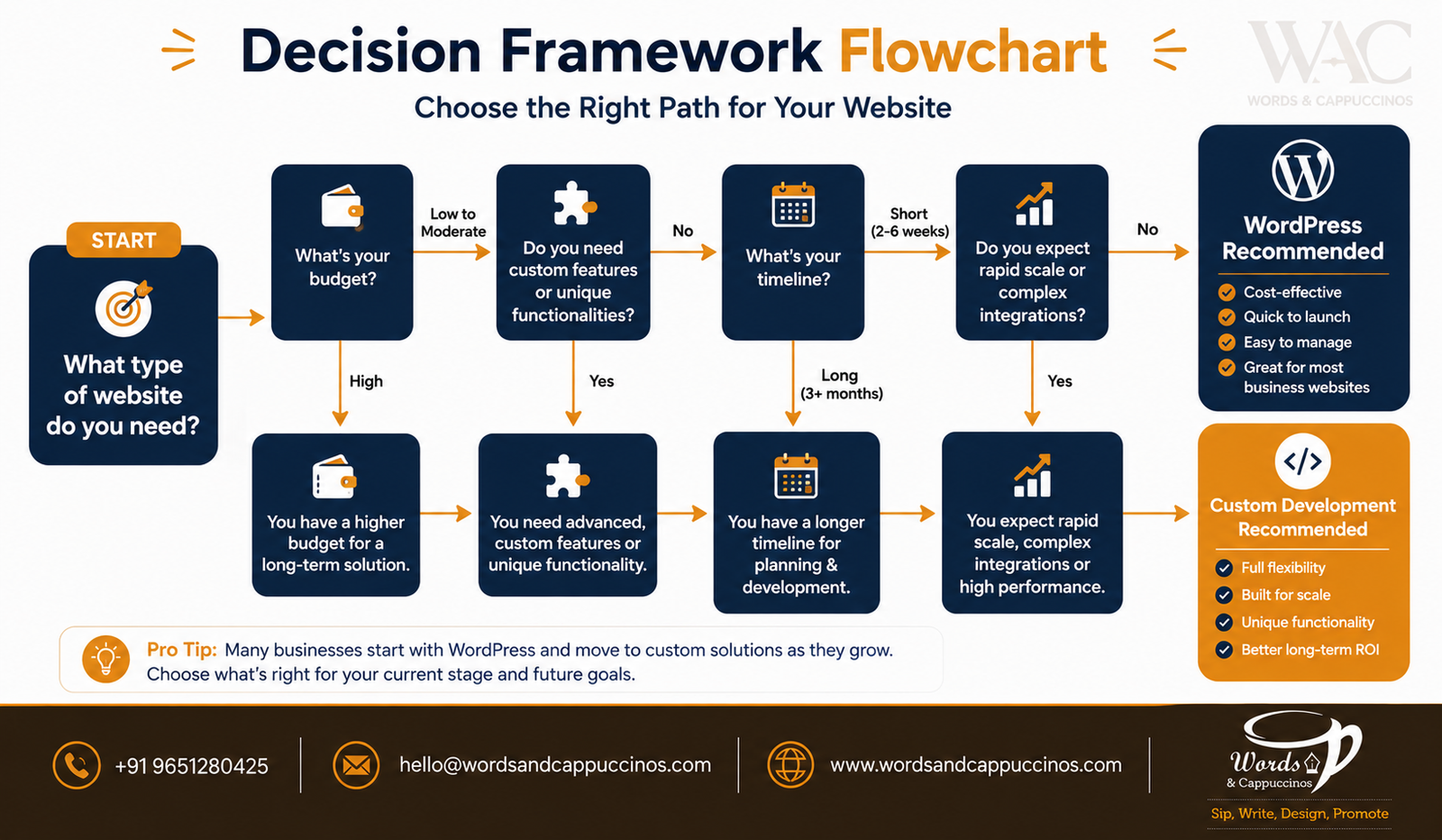 Choose WordPress when:
- You need a professional business website, service site, blog, portfolio, or standard e-commerce store
- Your budget is under ₹5,00,000 and you want maximum quality within that budget
- You want your team to be able to update content without contacting a developer
- You need to launch in weeks, not months
- Your SEO strategy is primarily content marketing as you will be publishing blogs, guides, and landing pages regularly
- You are a startup, SME, local business, professional services firm, or D2C brand selling a defined product range
- You want a platform with a massive support community and the widest ecosystem of integrations
Choose Custom Development when:
- Your product is the website — a SaaS platform, marketplace, or web application with unique business logic
- You require real-time features, complex data relationships, or proprietary algorithms that no CMS can handle
- Performance is a commercial requirement (not just a preference), for example, a high-SKU e-commerce platform where every 100ms of load time has a measurable conversion rate impact
- Your security requirements are above standard — financial services, healthcare data handling, or government compliance
- You are building something that genuinely does not fit any existing platform category
- Budget is not the primary constraint and long-term control, performance, and differentiation are the priorities
Choose Headless WordPress when:
- You want WordPress’s content management ease but custom development’s performance ceiling
- You have an active content team that publishes frequently and needs editorial independence
- Your PageSpeed requirements are 95+ and your content volume makes standard WordPress optimisation insufficient
- You want a middle path between the two that scales into custom territory without starting from scratch
4 Red Flags: Signs Your Agency Is Recommending the Wrong Platform
Not every web development recommendation is made in your interest. Custom development carries a higher margin for agencies. WordPress projects are sometimes dismissed as “not professional” to justify higher project budgets. Here are the four warning signs that you are being pushed toward the wrong platform:
- Custom development is recommended without first asking about your content management needs. If an agency recommends custom development without discussing whether your team can manage the site after launch, they have not done the discovery properly. Management ease is a fundamental requirement, not an afterthought.
- WordPress is dismissed as “not suitable for professional businesses.” WordPress powers major news organisations, large e-commerce platforms, and enterprise corporate websites globally. Any blanket claim that WordPress is not suitable for professional use is false and almost certainly motivated by the higher margins that custom development carries.
- No mention of Core Web Vitals, page speed, or ongoing performance. Any competent web development company should be discussing performance requirements upfront regardless of platform. If a conversation about platform choice does not include performance benchmarks, the agency is thinking about delivery, not results. You can review Google’s Core Web Vitals documentation to understand what performance metrics actually matter for rankings.
- No post-launch maintenance plan is discussed before the project begins. The ongoing cost of a website is as important as the upfront cost. An agency that does not discuss maintenance, plugin update strategy, hosting requirements, and security monitoring before you sign is not giving you a complete picture of the investment.
Why Words And Cappuccinos for WordPress and Custom Website Development in India
Words And Cappuccinos is a full-service agency with 16+ years of website development experience across India and internationally. We have built WordPress sites, custom web applications, e-commerce platforms, and headless WordPress architectures for 5,000+ clients across 18+ industries.
Our platform recommendation process starts with your business goals, not our project margin. A discovery call covers your content management needs, SEO strategy, performance requirements, budget, timeline, and growth plans — and the recommendation that follows is based on what is genuinely right for your situation.
- WordPress development: Business websites, e-commerce (WooCommerce), blogs, corporate sites, landing pages. Complete SEO setup with Rank Math, Core Web Vitals optimisation, CMS training, and documented handover.
- Custom development: Web applications, SaaS products, marketplaces, enterprise portals. Built with modern frameworks including React, Next.js, Laravel, and Node.js.
- Headless WordPress: For businesses that want the best of both; WordPress content management with custom frontend performance.
- Integrated content + SEO: Every WAC website project includes content strategy, keyword architecture, and on-page SEO setup so the site is built to rank and convert from day one, not retrofitted for search after launch.
Explore our website development services, custom website development, UI-UX design, and e-commerce development services or contact us to discuss your specific project.
Frequently Asked Questions: WordPress vs Custom Website Development India
Is WordPress good enough for a professional business website in India?
Yes. WordPress powers over 43% of all websites globally including major corporations, news organisations, and large e-commerce platforms. For the vast majority of Indian businesses like service companies, startups, D2C brands, professional services firms, and content-driven businesses, WordPress delivers professional results that are indistinguishable from custom development in the eyes of both visitors and search engines. The idea that WordPress is “not professional” is a myth.
Can I switch from WordPress to a custom website later?
Yes, but it involves rebuilding the site rather than migrating it. Your content can be exported from WordPress and imported into a new system, but your design, templates, and custom functionality need to be rebuilt from scratch on the new platform. This is why the platform decision matters upfront; switching later is expensive and time-consuming. That said, if your business has outgrown WordPress, a migration is entirely feasible and WAC handles this regularly for growing clients.
Which is better for SEO — WordPress or custom development?
For most Indian businesses, WordPress with Rank Math or Yoast SEO is the stronger practical choice because it provides a powerful SEO toolset out of the box and makes content publishing frictionless which is the most important factor in long-term organic growth. Custom websites can achieve superior technical SEO performance (higher Core Web Vitals scores, more precise page architecture), but only when deliberately engineered for it. A poorly built custom site will underperform a well-optimised WordPress site in search every time.
How long does a WordPress website take to build in India vs a custom website?
A professional WordPress business website takes 2 to 8 weeks depending on complexity, number of pages, and design requirements. A custom website development project typically takes 3 to 12 months for the same scope because everything is built from scratch without the foundation that WordPress provides. For businesses with time-sensitive launches, this timeline difference alone often makes WordPress the correct choice.
Is WordPress secure enough for an Indian business website?
WordPress security is primarily a maintenance discipline, not a platform limitation. A WordPress site with regular core and plugin updates, a reputable security plugin (Wordfence or Sucuri), quality hosting with firewall protection, and strong admin credentials is secure for the vast majority of business applications. Custom websites have a smaller default attack surface but introduce their own security considerations if not engineered carefully. For businesses handling sensitive financial or healthcare data with specific compliance requirements, the security conversation should involve a technical consultant regardless of platform choice.
What is the difference between WordPress and a custom CMS?
WordPress is an off-the-shelf CMS — a pre-built content management system with a standardised interface and a large ecosystem of extensions. A custom CMS is built specifically for a project, with an admin interface, content types, and workflow designed precisely for that organisation’s needs. Custom CMSs are appropriate for large organisations with unique content requirements. For most Indian businesses, WordPress provides more than sufficient CMS capability at a fraction of the cost and build time of a custom CMS.
Can WordPress handle high traffic for an Indian website?
Yes, with the right infrastructure. WordPress scales to handle millions of monthly visitors when hosted on appropriate infrastructure like VPS or cloud hosting (AWS, Google Cloud), a CDN, server-side caching (LiteSpeed, Redis), and a well-maintained plugin architecture. The platforms running major Indian media publications and large e-commerce stores demonstrate this at scale. Shared hosting is inappropriate for high-traffic WordPress sites, but that is an infrastructure decision, not a platform limitation.
Does Words And Cappuccinos build both WordPress and custom websites?
Yes. WAC builds both WordPress and custom websites, and recommends the right platform based on your specific goals, budget, and requirements; not based on which carries higher development margins. We also build headless WordPress architectures for businesses that need both platforms’ strengths. Contact us at wordsandcappuccinos.com/contact-us for a no-obligation platform recommendation discussion.
Conclusion
The WordPress vs custom website development decision is not a question of which platform is better. It is a question of which platform is better for your specific situation. WordPress is the right answer for most Indian businesses and it is the right answer not as a compromise but as a genuinely powerful choice that delivers professional results quickly and affordably.
Custom development is the right answer when your project genuinely requires it when WordPress cannot do what you need, when performance is a commercial constraint, or when you are building a product rather than a marketing website. Headless WordPress is the right answer when you need both.
The most important thing you can do before making this decision is have an honest conversation with your development partner about your goals, your team’s content management needs, your budget over three years (not just upfront), and your growth plans. For more on how to evaluate web development proposals and partners, read our guide on how to choose the best web development company in India and our piece on website development costs in India 2026.
WordPress or custom — we build both, and we will tell you which one you actually need. Words And Cappuccinos provides WordPress development, custom website development, headless WordPress, and e-commerce development for Indian businesses and international brands – always starting with the platform recommendation that is right for your goals, not your agency’s margin.
Get a free platform recommendation discussion: wordsandcappuccinos.com/contact-us | WhatsApp: +91 9651280425


Ankita Gupta
Our Founder
Ankita founded Words And Cappuccinos to prove that good writing is a business asset, not a line item. She leads strategy across every account.