What is On Page SEO
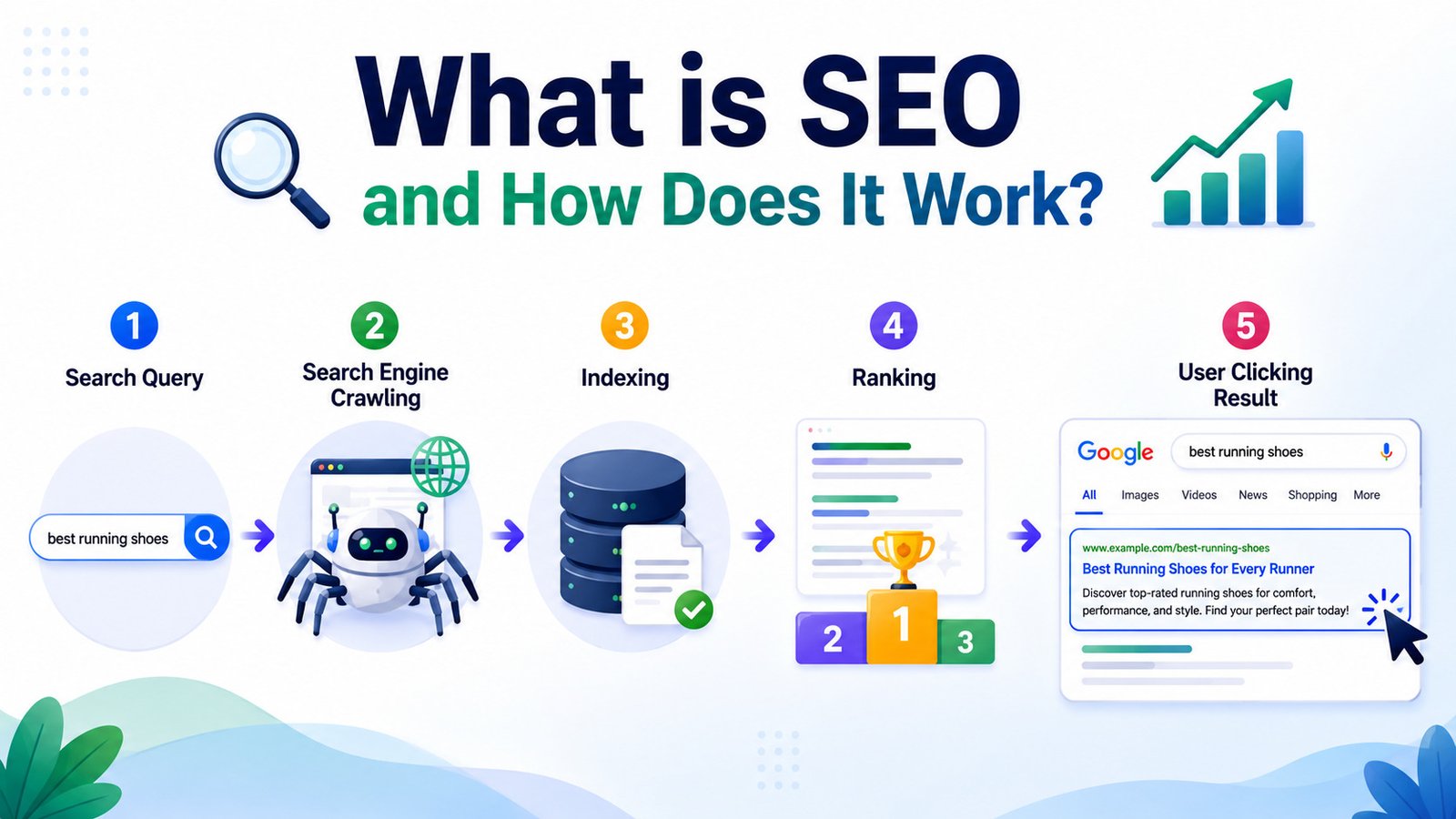
Learning what on-page SEO is essential for brands that are looking to improve their website’s visibility and rank higher in search results. On-page SEO is the technique of optimizing pages. It helps rank web pages high on search results and drives more traffic.
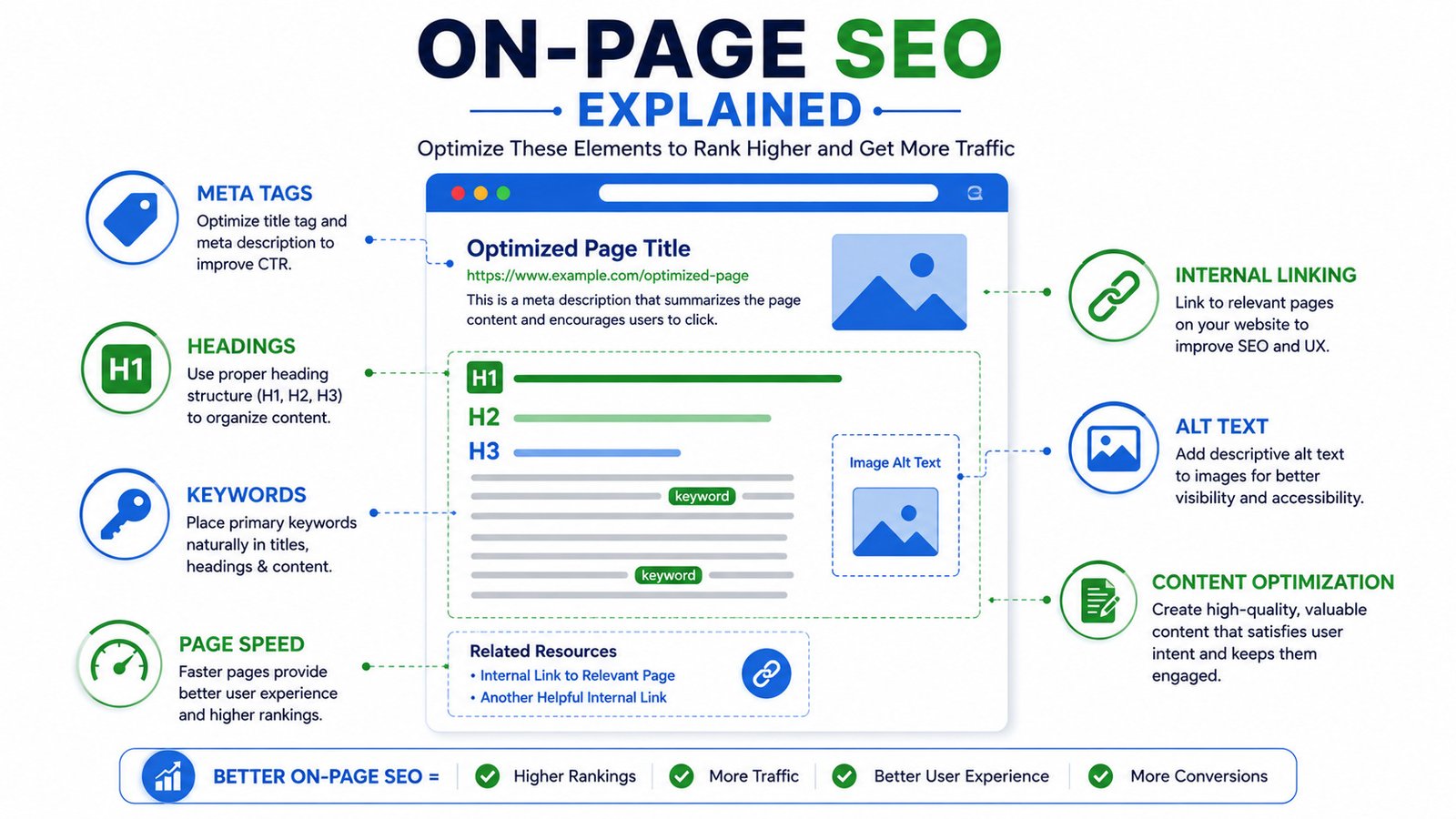
The on-page SEO meaning includes all the features that directly control the website. A good on-page SEO includes keyword usage, content quality, meta tags, meta descriptions, headings, alt text, internal links, and page structure. On-page SEO aids search engines like Google to understand your content, thereby improving the user experience for visitors to the page.
A simple on-page SEO definition is: the process of optimizing content and improving the structure of a website page to enhance search engine rankings and audience engagement.
On-page SEO differs from off-page SEO. On-page SEO involves optimizing the website. On the other hand, off-page SEO focuses on external factors, such as brand mentions, backlinks, and social signals, to improve search rankings. However, in the digital space, on-page and off-page SEO are both important.
Yet on-page SEO is more important, as it is the foundation for website ranking and helps search engines accurately evaluate web page content.
Search engines like Google use on-page signals to determine whether a page matches the user’s search intent. A well-optimized web page helps search engines to crawl, index, and rank the content. Whereas factors such as clearer headings, keyword relevance, page load speed, and useful content contribute to stronger rankings.
Failing to perform proper on-page optimization, even with high-quality content, can make your website struggle in search results.
Why is On-Page SEO Important?
Understanding the importance of on-page SEO helps brands create useful content that performs well in search engines. In addition, it helps businesses deliver a better user experience. Your webpage will struggle to show results if it is not properly optimized, even if it offers the widest range of products or services.
One of the foremost benefits of on-page SEO is improving the overall visibility in search results. Search engines like Google evaluate each page of the website. It analyses factors such as keywords, page content, headings, metadata, and structure to better understand the website.
Correct on-page optimization helps search engines ensure the content aligns with the user’s search intent. Well-optimized on-page SEO increases the likelihood of ranking highly in search results.
The second benefit is relevance. When a page is optimized with headings, titles, internal links, and keyword placement, it helps search engines better understand the topic and the purpose it serves users. It helps search engines index the page and helps pages compete for the right search queries.
The third is user experience. It plays a major role in improving the SEO performance. Search engines capture information from a page and evaluate whether it has clear formatting, a responsive layout, loads quickly, and provides useful information that keeps visitors engaged. Positive user behavior signals to support better rankings.
The importance of on-page SEO is to improve overall click-through rates (CTR). Elements such as strong meta tags and meta descriptions encourage users to click your page instead of competing results. Higher CTR drives traffic and improves visibility.
Overall, on-page SEO helps websites become easily visible to users, easy to understand, and more valuable to search engines and users.
How On-page SEO Works?
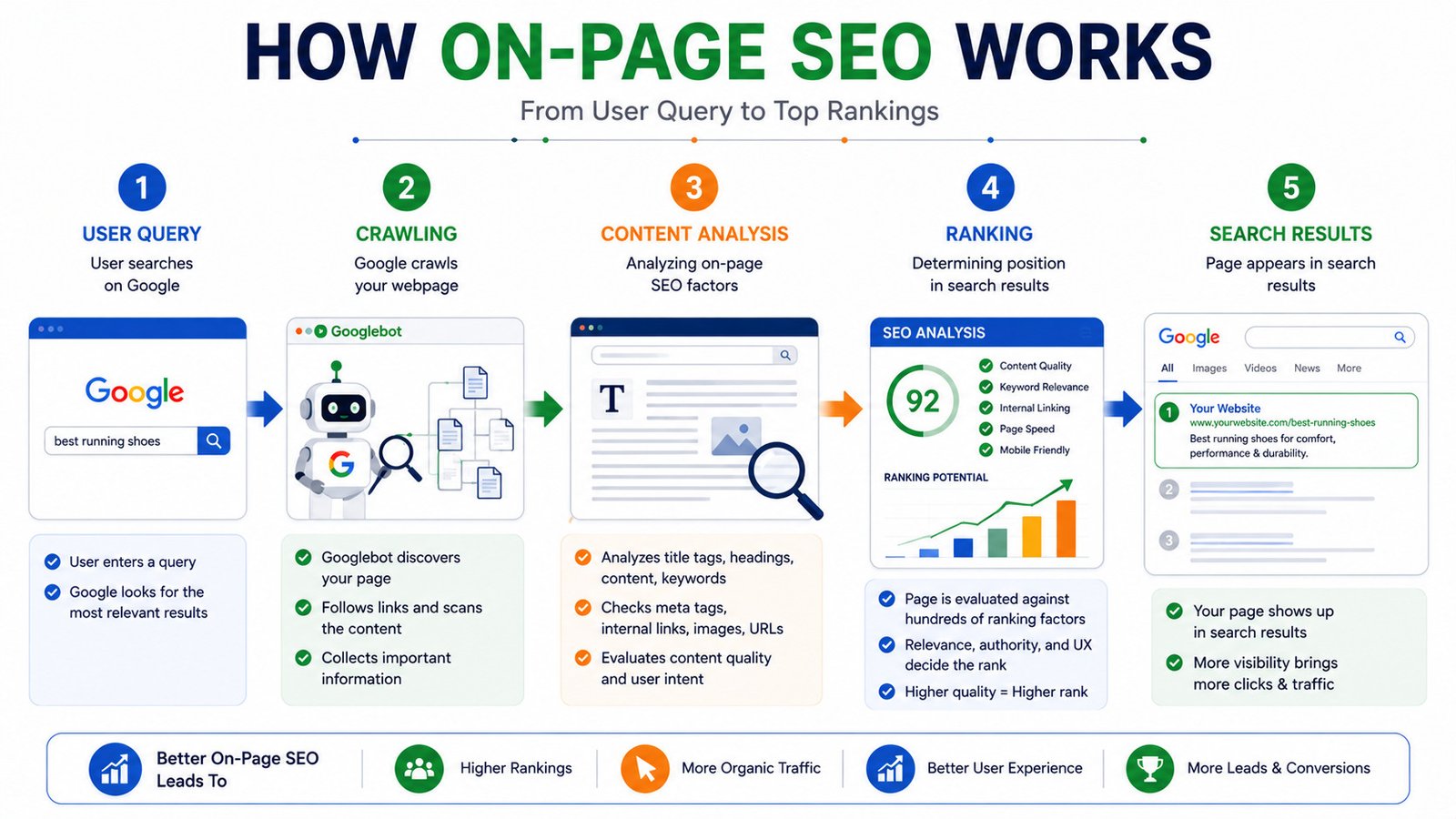
On-page SEO plays a key role in aiding search engines to understand the content. It helps search engines determine whether the information matches the search query. Most search engines, such as Google, use automated systems to crawl webpages. It later analyzes content and ranks pages based on quality, relevance, and user experience.
Well-performing on-page SEO enhances the elements of your content, making it appear more relevant in search results.
Search Engines Analyze Content
A search engine uses the webpage to crawl the information. It examines multiple elements to understand the topic and its value to the user. This includes:
- Page title or Meta tag
- Headings
- Body content
- Images and alt text
- Internal links
- URL
- Meta descriptions
Furthermore, search engines evaluate if the information is organized and satisfies the user’s search intent. It is when search intent optimization becomes vital. A page should align with what users are searching for in Google queries.
For example:
A user adds a query of “how to improve website speed” into Google. The user expects practical tips and solutions in search results, rather than a sales-focused product page. Herein, when a search engine finds a page that aligns with the search intent, it will rank it among the top search results.
Similarly, Google analyzes content quality signals such as originality, depth of information, readability, field expertise, and usefulness to users. High-quality content will answer all the user questions and thus perform well in the search rankings.
Relevance and Keywords
Keywords are yet another core aspect of on-page SEO. They help the search engine understand what information the page offers. However, modern SEO is about more than repeating the same set of keywords.
Search engines evaluate the content and its overall meaning based on the relevance of the phrases and the semantic keywords used. These terms connect the main topic and provide a broader context.
For example:
A website page targeting “on-page SEO” will have the following keywords and phrases:
- Meta tags
- Keyword optimization
- Internal linking
- Page structure
- Search rankings
It is necessary to use the keywords naturally in content, headings, image alt text, and title tags. It helps in strengthening the relevance of the content without making the page feel forced.
Google’s algorithms are designed to make content sound natural and to help users distinguish between content written for search engines and content written for users.
User Experience Signals
User experience is another important factor that affects on-page SEO. Search engines must monitor how users interact with webpages when clicking search results.
The user experience signals include:
- Responsiveness on different devices
- Smooth navigation of pages
- Fast loading of pages
- Low bounce rates
- Easy readability and structure
- Time spent on each page
If users leave the page, the page loads slowly, or the information fails to answer the query, search engines may view it as less valuable.
On-page SEO improves these signals by creating webpages that are easy to read, accessible across devices, and well-structured.
When the content is informative, includes relevant keywords, and offers the user a good experience, it helps make the webpages more competitive in organic search rankings.
Core elements of On-Page SEO
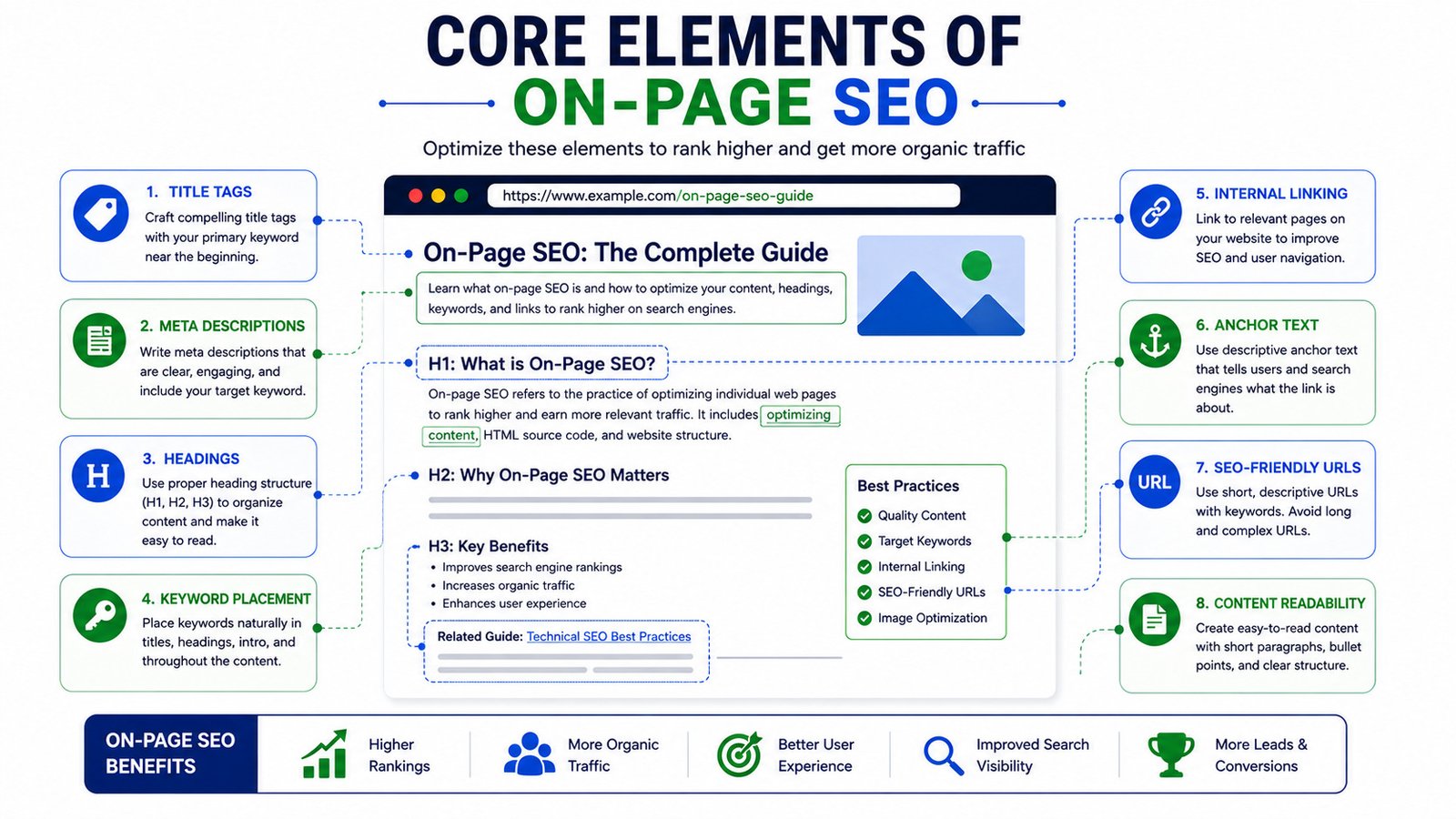
Having sufficient knowledge of on-page SEO elements is essential for improving search results. These include factors like user experience, search visibility, and content performance. A search engine evaluates multiple elements. They help determine if the webpage deserves to rank for a particular search.
A strong on-page SEO strategy combines many factors. These are content quality, technical structure, keywords, and usability. Each SEO element works together to help search engines determine whether the page adds value to users.
Below are the components enabling effective on-page SEO:
Title Tags Optimization
Title tags are an on-page SEO factor. It helps search engines and users learn about the webpage’s topic.
A title tag includes:
- Search engine results
- In browser tabs
- Pages shared online
- Well-optimized titles improve the overall ranking and click-through rates (CTR).
- Best Practices for Title Tags
- A good meta tag must include:
- Primary keyword
- Must describe the page topic
- Be readable and concise
- Encourage users to click the page
For example: A weak meta title is an SEO Page
A good meta title is “On-Page SEO Guide for Beginners.
Search engines must treat meta titles as a relevant signal, and they should be descriptive and unique.
Avoid these:
- Keyword stuffing
- Duplicating titles
- Improper information
- Long titles
Meta Descriptions
Meta descriptions are summaries of a page’s topic that are written below the title in search results. They wouldn’t help in direct ranking. However, they do influence the click-through rates (CTR). A strong meta description that offers users a reason to visit the page:
Tips for effective meta description
These must include:
- Page summary
- Relevant keywords
- Character limits
Example:
Discover how on-page SEO helps improve ranks with content optimization, keyword relevance, and visitor experience.
A strong meta description must improve the search visibility to increase user engagement in search results.
Avoid these:
- Repeated meta description
- Vague summaries
- Keyword stuffing
- Short descriptions
Heading Tags Structure
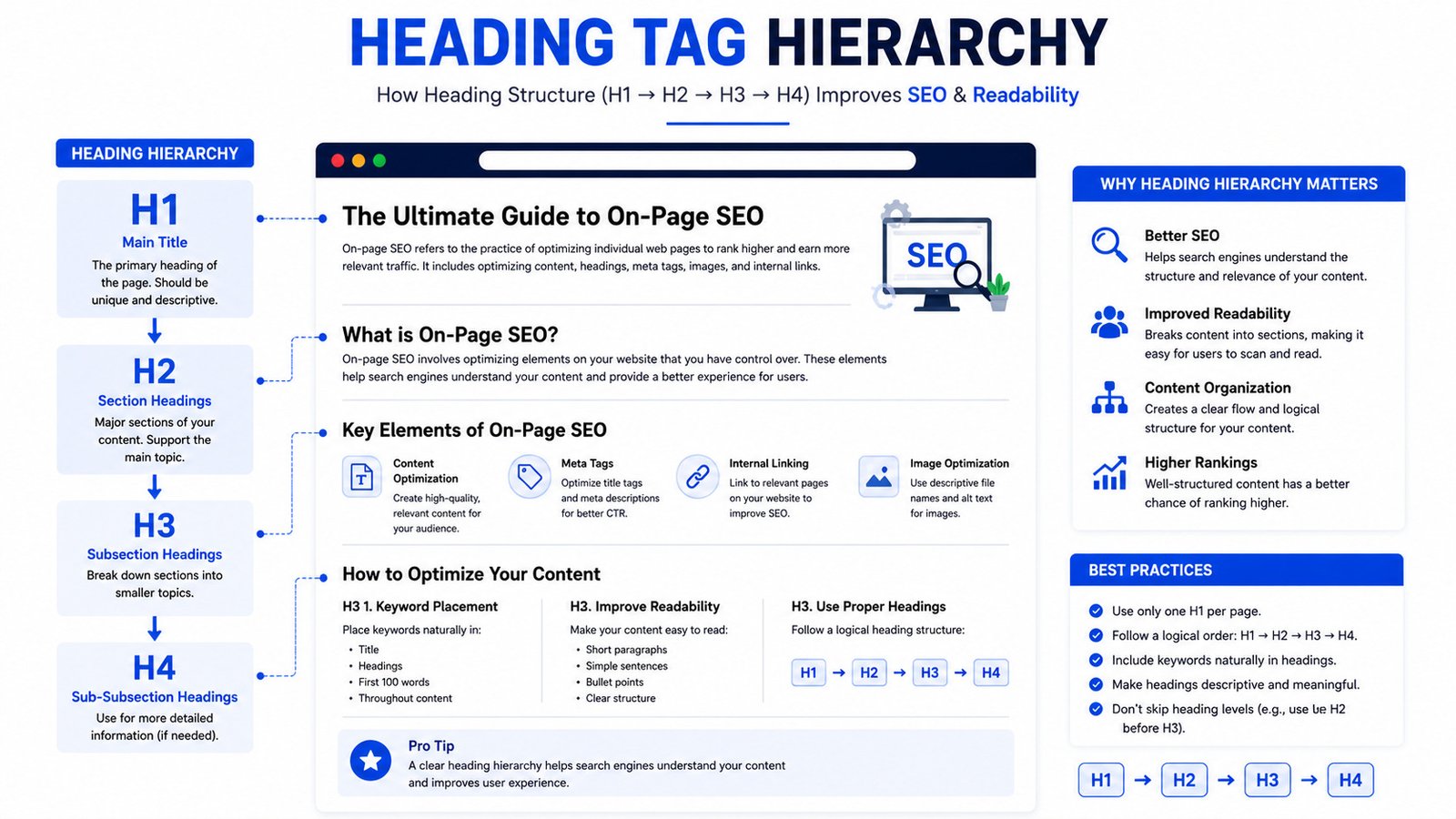
A heading tag organizes content. It improves readability and helps search engines arrange the information.
Common Heading Structure must include:
- Topic Title – H1
- Main Sections – H2
- Subsections – H3
- Supporting points – H4
A webpage must have only one H1 tag. It must highlight the main topic.
For example:
Topic: Guide to Understand On-Page SEO for Beginners
H1 – On-Page SEO Guide
H2 – Content Optimization
H3 – Keyword Relevance
H3 – Image Optimization
Importance of Heading Structure
Using proper headings improves overall readability. It assists search engines in scanning the overall website content. These factors are structuring information, strengthening keywords, and enhancing accessibility.
Search engines include headings to understand the content and determine whether it focuses on each section.
Keyword Placement
The search engine uses keywords to identify the content’s topic. However, SEO also focuses on naturally optimizing content without excessive keyword repetition.
A strong keyword placement must include:
- Title tags
- Headings
- Introduction
- Body of the content
- Alt text of images
- URL
- Meta descriptions
- Keyword Density
Keyword density is the total number of times the keyword appears in content compared to the total word count. However, there is no particular percentage for keyword density. It is necessary to avoid overusing keywords, as this can affect readability.
Prioritize the following:
- Natural language
- Semantic keywords
- Relevance of topic
- Quality of content
For example:
Content that targets “on-page SEO” must include terms like:
- Search rankings
- Internal linking
- Content optimization
- SEO structure
These factors help in creating relevant content without sounding forced.
Internal Linking
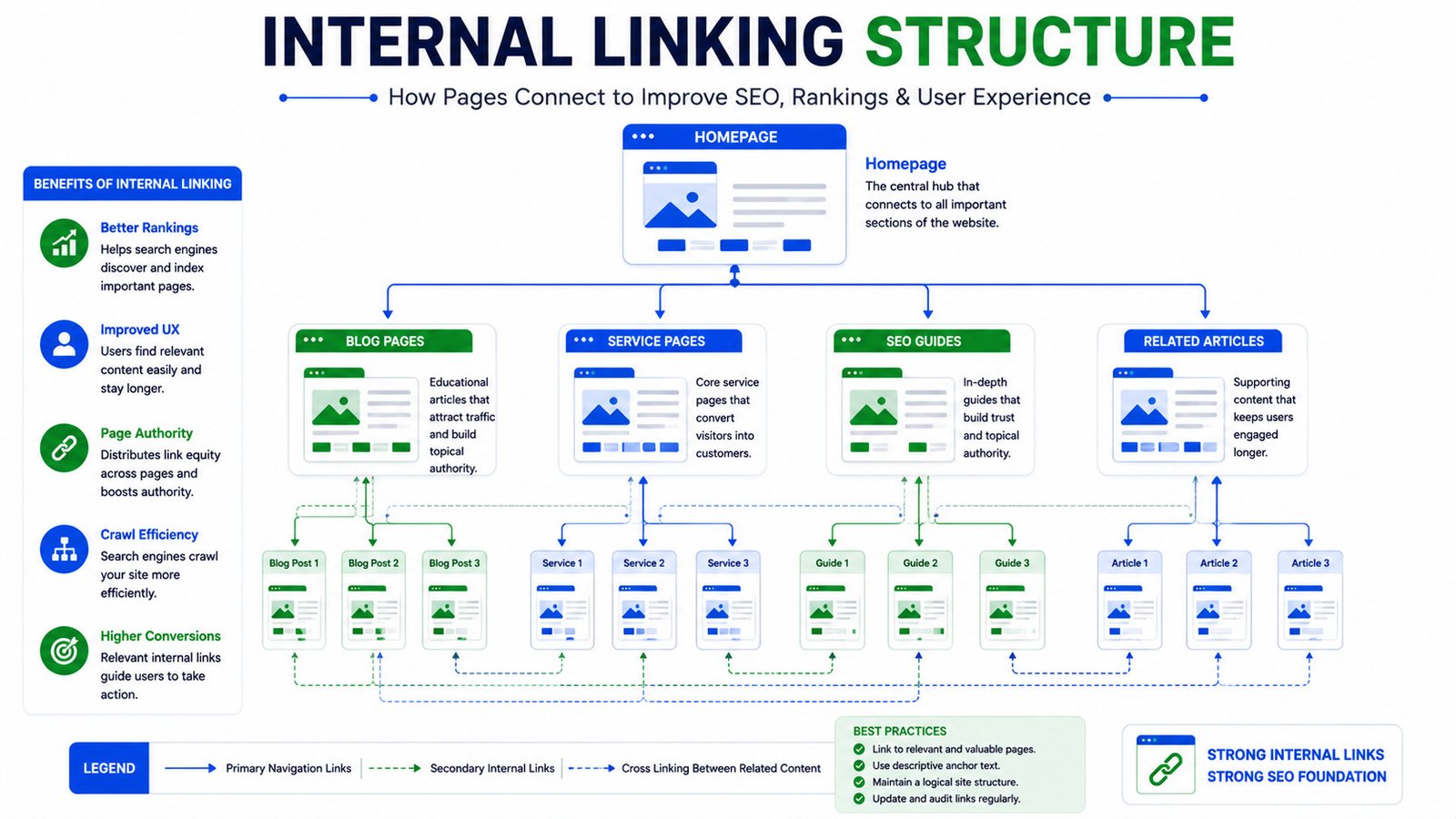
Internal linking connects pages within a website. These are very valuable and must not be overlooked. Internal linking helps in:
- Crawling pages for search engines
- Distributing authority across the site
- Increasing user time on the site
- Guiding users to find related content
For example:
A blog dealing with keywords must link pages to:
An article that describes content optimization
- Guide on technical SEO
- Information on SEO tools
- Best Practices for Internal Linking
- An effective internal linking must:
- Connect the page with relevant pages
- Use descriptive anchor text
- Avoid excessive linking
- Help users discover useful information
Good internal linking helps in making the website structure look organized and improves the user experience.
Anchor Text Optimization
Anchor texts are clickable links. The search engine traces the anchor text to understand the context of each linked page.
For example:
- A weak anchor text is: “Click here.”
- A strong anchor text is “on-page SEO checklist.”
An optimized anchor text provides the search engine with proper topic relevance and improves overall navigation.
Types of Anchor Text
Some of the commonly used anchor texts are:
- Exact match keywords
- Partial match keywords
- Branded text
- Natural phrases
The content must use a balanced approach to all the anchor tests. Overusing exact-match anchor text can make the content seem redundant.
Things to Follow for Strong Anchor Text
A strong anchor text must:
- Describe the pages linked
- Improve user understanding
- Avoid overusage of generic wordings.
SEO-Friendly Content
Good, informative, and effective content is the foundation of SEO. Search engines value information that is relevant and aligns with the visitor’s search intent. SEO-friendly content must:
- Answer the user questions
- Offer relevant information
- Include relevant keywords
- Helps in easy navigation
- Offers value
Characteristics of Strong Content Optimization
A good content optimization must:
- Cover the topic in detail
- Use semantic keywords
- Have logical formatting
- Strong readability
- Relevant keyword usage and examples
The content must focus on answering the user query rather than just using keywords. Search engine value content that offers:
- Expertise
- Trust
- Authority
- Relevance
Practices to Avoid
Weak content will lower the content ranking. Some of the examples include:
- Short pages
- Duplicate content
- Paragraphs that are stuffed with keywords and little information
- Detailed, well-informed content performs better in organic search results than keyword-stuffed content.
Content Readability
Content readability allows users to understand the information provided. It improves the overall engagement, reduces the bounce rates, and offers a better user experience.
Methods to Improve Readability
A good, readable content must include:
- Short paragraphs
- Easy to understand language
- Bullet points
- Descriptive headings
- Sentence structuring
Readers look for content that is worth reading. Well-formatted, organized content helps users find important information.
Why Readability Matters in SEO
Search engine evaluates user behavior signals like:
- Time spent on the page
- Bounce rates
- Engagement
Difficult-to-read content can cause readers to leave the page quickly. A readable content supports:
- Better user involvement
- Improved information
- User satisfaction
- High conversion
How to use all On-Page SEO Elements for SEO
An effective on-page SEO combines all the elements. A well-optimized page must include:
- Proper titles
- Descriptive meta descriptions
- Heading structure
- Keyword placements
- Strong internal linking
- Anchor texts that are optimized
- High-quality and informative content
- High readability.
Each element helps both users and search engines understand the topic and improve the user experience.
Instead of treating SEO as a checklist, websites must focus on creating pages that are informative, accessible, and useful for the readers. When all the core factors are combined, web pages become more competitive in search engines and more valuable to users in the long term.
On-Page SEO Techniques That Improve Rankings
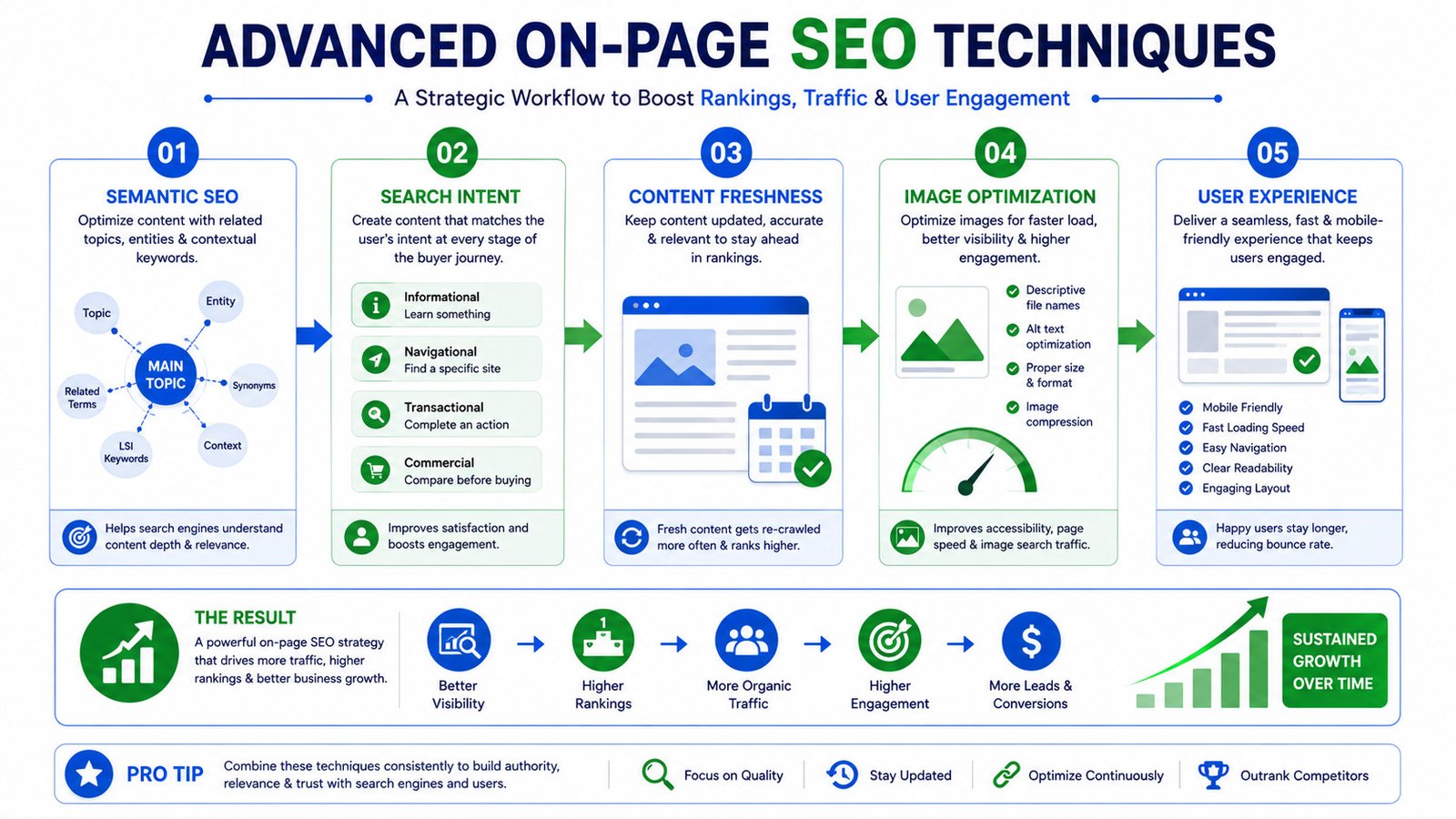
On-page SEO techniques help search engines better understand content and improve the user experience.
- A good on-page SEO optimization focuses on factors such as user intent, content quality, relevance, and technical usability.
- A strong on-page SEO strategy balances multiple methods to improve user engagement, ranking, and visibility over time.
Semantic Optimization
Semantic optimization helps search engines understand the overall meaning and context of a topic. It just doesn’t focus on matching exact keywords.
Instead of repeating keywords or phrases, on-page SEO optimization uses related terms, supporting phrases, and topic variations throughout the content.
For example, a page that is targeting “Topic – on-page SEO” must include terms like:
- Meta tags
- Internal linking
- Keyword placement
- Search rankings
- Content structure
- Page speed
The use of related phrases is called semantic keywords. They help search engines interpret the topic, understand the content, and improve overall readability, which is informative to users.
Search Intent Match
An effective SEO technique is to align content with user search intent. Search engines value pages that the users are looking for.
Some of the common search intents include:
- Informational content – which answers the user’s questions
- Navigational content – when users are searching for a specific brand or website
- Transactional content – based on what users are buying or want to take action
- Commercial – when users are comparing the products or services
For example, users searching for “best SEO tools” are looking for comparison and recommendations. On the other hand, users searching for “what is SEO” expect to find informative and educational content.
For improving rankings, users must:
- Identify the user intent behind the target keyword
- Evaluate the search results of competitors
- Create content that answers queries related to user needs
- If the information is structured clearly
Content must align with search intent to improve engagement and ranking performance.
Content Freshness
The content must be new and add value to the readers. Content freshness is the most important factor for ranking on search results. Search engines prefer updated, relevant content, especially when topics change frequently.
Refining the old pages improves the overall ranking. This includes:
- Refining and updating outdated statistics
- Adding the latest information
- Improving keyword relevance
- Improving information
- Fixing broken links
- Improving readability
Regularly updating content signals to the search engine that the website is active and well-maintained. Adding fresh content builds user trust. A good on-page SEO strategy must include regular content auditing to identify which pages require improvement.
Image Optimization
Optimizing images is equally important as optimizing content. It not only improves engagement but also makes the content easier to understand. Image optimization improves overall page speed, makes it easier for visitors to access the website, enhances the user experience, and boosts search visibility.
Here are the key aspects to consider when optimizing images:
File Name
Use descriptive file names instead of vague ones like “IMG1234.jpg”. For the image for a blog on SEO best practices, the image names can be saved as:
“On-page-seo-checklist.jpg or keyword-research-guide.jpg”
This allows the search engine to learn about the image’s context.
Alt Text
Alt text provides search engines and readers with details about the image. A well-written alt text betters accessibility. Additionally, it helps the Google Image Search index images.
For example:
“SEO professional auditing website rankings on the dashboard”
This alt text provides a clear and relevant description of the image.
Compressed Images
Larger files can slow down the loading of your website page. This can negatively impact the audience experience on the website and search engine rankings.
Compressing images helps load pages faster and maintain visual quality.
Enhance Content Structure
Well-formatted content is pleasing to both users and search engines. An effective formatting of content includes:
- Short and simpler paragraphs
- Easy language
- Bullet points
- Descriptive headings
- Clear spacing
Well-organized content improves readability. It helps users scan for information more quickly. Search engines value the content that uses headings to understand page formatting and topic hierarchy.
Titles and Meta Descriptions
Title tags, or meta titles, are the most essential on-page SEO elements. A good title must have:
- Target keyword
- Clearly describe the page
- Encourage users to click and read
- Should be concise
Meta descriptions do not directly help improve rankings. However, it can increase the overall click-through rates by making the search results more appealing.
Internal Linking
These are how webpages connect to other pages of the websites. Internal linking helps distribute page authority. It also helps search engines improve crawlability, guide users to related, useful content on the site, and increase the time visitors spend on the site.
A good SEO strategy includes strategic internal linking that encourages users to explore more and improves search engine navigation.
User Experience
User experience is closely tied to overall SEO performance. Search engines tend to monitor user interactions with webpages after users click on search results. It is necessary to incorporate the UX factors that can improve the user experience, which include:
- Mobile responsiveness
- Faster loading
- Easy navigation
- Readability
- Low bounce rates
A good user experience can increase website engagement and support stronger search engine rankings.
A successful on-page SEO optimization requires going beyond adding basic keywords. Effective strategies often combine semantic relevance, alignment with search intent, content uniqueness, optimized images, and user experience.
Applying and refining on-page SEO techniques helps websites improve visibility, drive more traffic, and build long-term search engine authority.
On-Page SEO Checklist for Beginners
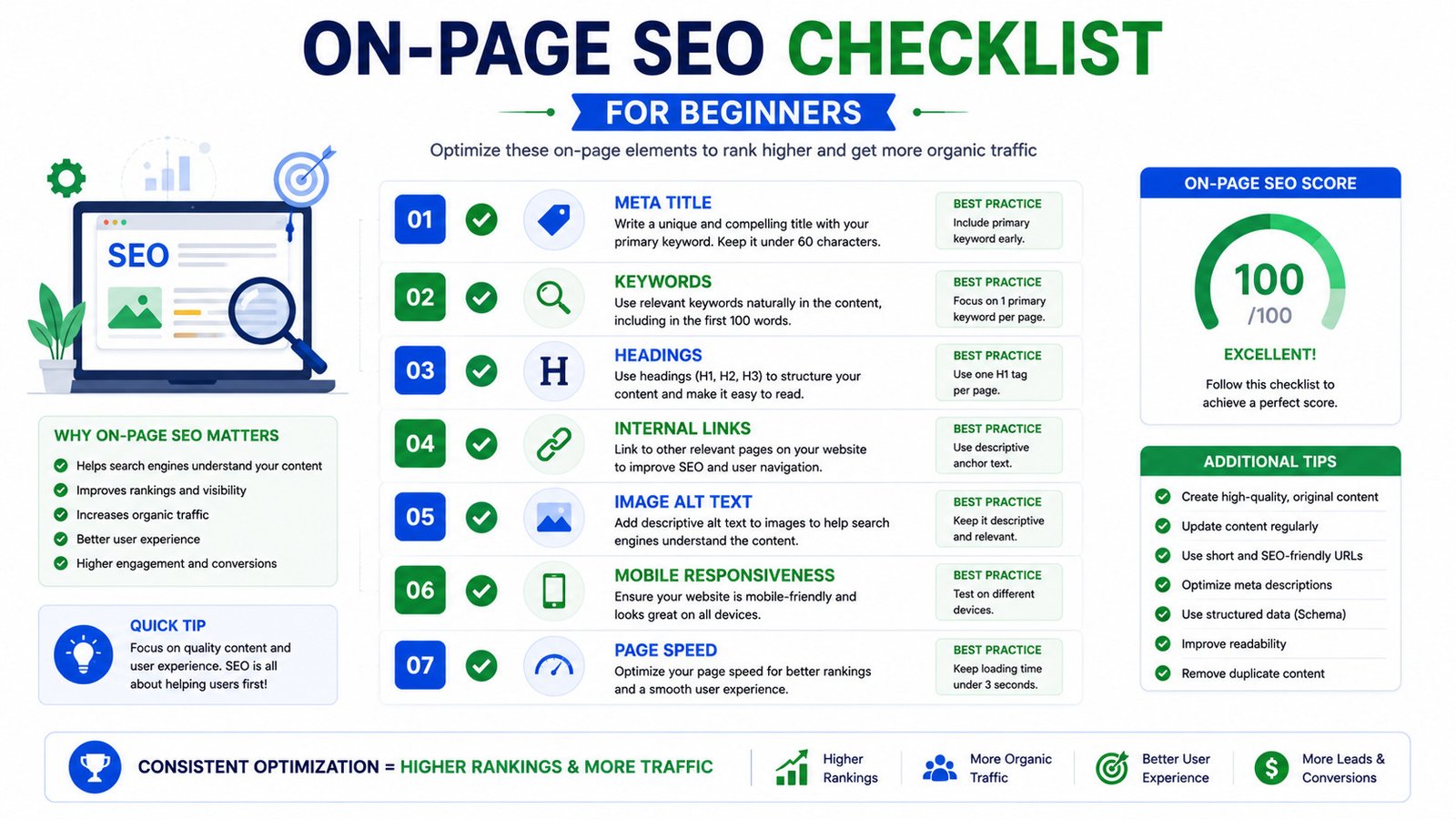
Are you a beginner in SEO? Here is a structured on-page SEO checklist to help you optimize webpages effectively. On-page SEO focuses more on improving the elements of the website. It helps search engines understand your content and makes it easier for users to navigate the pages.
Here is a quick on-page SEO for beginners guide which covers major optimization steps:
| Element | How it is used | Benefit |
| Keyword Research | Firstly, select a primary keyword. In addition, add a few related keywords distributed evenly throughout the content without stuffing. | It helps search engines accurately understand webpages. |
| Meta Tag Optimization | Use the primary keyword in the title without exceeding the 60-character limit. | Helps improve the overall ranking and CTR of content. |
| Meta Description | Write a clear, engaging meta description. It must include relevant keywords, but must not be stuffed with too many at once. | It provides a snippet of the article and encourages users to click through to the page in search results. |
| URL Structure | Use short and readable URLs. It must include the target or focus keyword. | Create URLs that are easier for users and search engines to understand and read. |
| Heading Tags | A properly structured content is well-received. Use heading tags like H1 for the main title and H2/H3 for subheadings. Avoid keyword stuffing to make it relevant. | It helps improve the structure of the content and overall readability. |
| Keyword Placement | Include keywords throughout the content, in the headings, introduction, and conclusion, in a very easy, smooth way. | It helps strengthen the content and make it relevant for search engines to crawl and index. |
| Content Quality | Develop content that is original, informative, useful, and easy to read for users, while also answering their questions. | High-quality content helps improve overall ranking and engagement. |
| Internal Linking | Link your content to other related pages within your own website. | It allows search engines to understand your site and keeps visitors engaged. |
| Image Optimization | Use compressed images. Include descriptive alt text.
| It improves the page speed and enhances accessibility. |
| Mobile Responsiveness | The pages must work and load across different devices, including smartphones and tablets. | Search engines like Google tend to choose mobile-friendly websites. |
| Page Speed | Optimize the loading time by reducing the usage of large files or unnecessary scripts. | Faster pages enhance user experience and search engine rankings. |
| Readability | Use short paragraphs and sentences. Use bullet points and simple language that are easy to understand for the target audience. | It makes it easy for users and search engines to scan and understand the content. |
| External Links | Link your content to other trustworthy sources whenever relevant | It makes the content more credible and enhances its overall value. |
| Schema Markup
| Include structured data whenever applicable. | It helps search engines to display user-friendly results to the audience. |
| Call-to-Action (CTA)
| Include a clear call to action for users to take the next step.
| Encourages user engagement and conversions.
|
A Quick On-Page SEO Tips for Beginners
Here are a few additional tips to strengthen your optimization:
- Write content that is useful to users first. Later, optimize it for search engines.
- Avoid stuffing keywords or overusing similar phrases
- Update old content regularly to keep the information fresh
- The anchor text must be descriptive for using internal links
- Use a unique title and meta description
A page with consistent on-page SEO enables search engines to understand the website and improve the user experience. For beginners, mastering these foundational steps can help improve long-term organic traffic and search visibility.
Common On-Page SEO Mistakes to Avoid
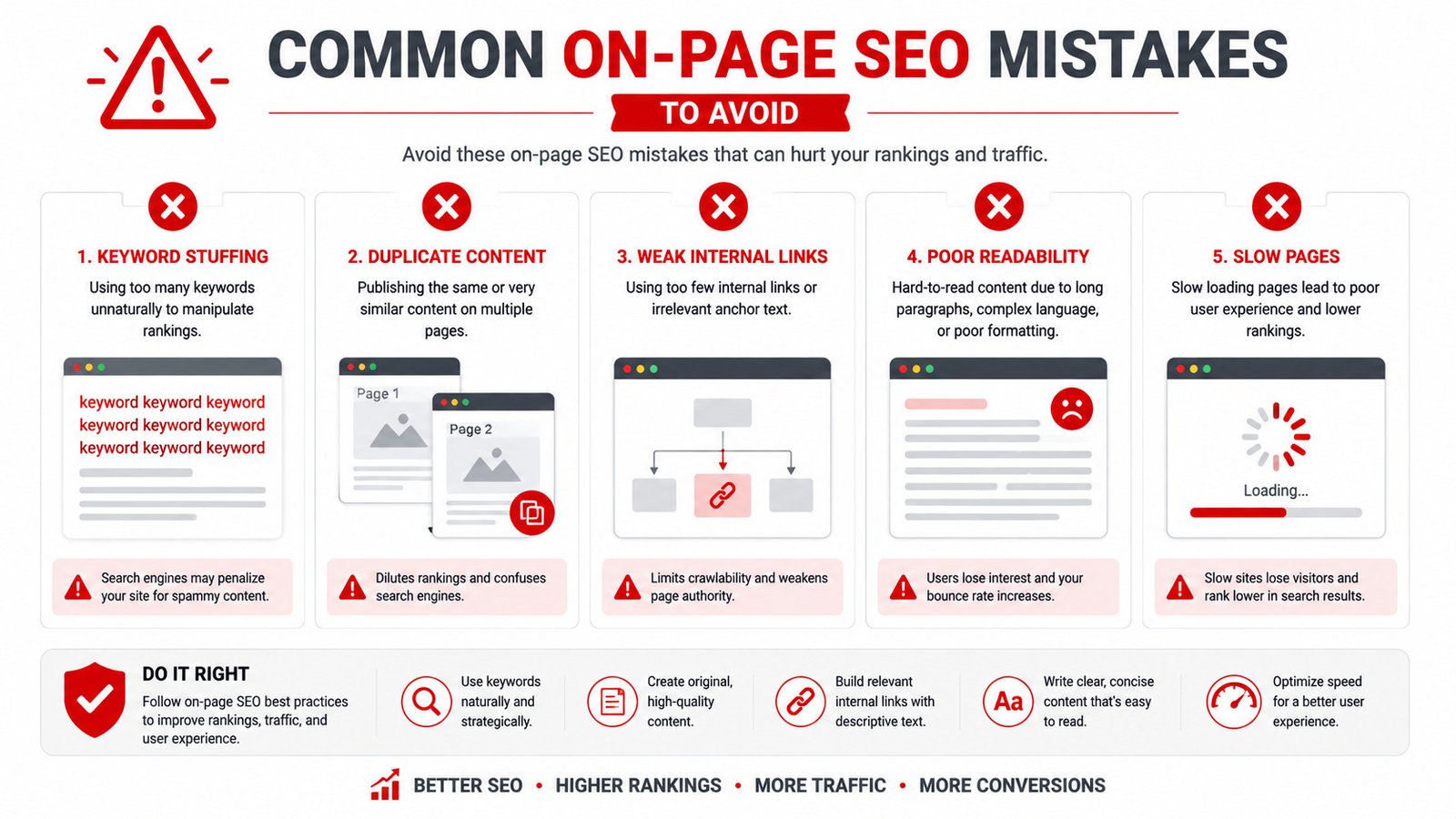
A well-designed website may also struggle to get clicks and traffic if basic on-page SEO mistakes are ignored. Avoiding these mistakes is essential to improving search rankings, user experience, and website performance.
Keyword Stuffing
Keyword stuffing is the most common mistake. This happens when the same keyword is repeated multiple times on a page to manipulate rankings.
For example, repeatedly using the same keyword in every paragraph can make the content sound weak and also difficult for users to read and understand. The search engine herein prioritizes content quality over user experience rather than keyword overuse.
Thus, instead of repeating the same keyword, include related terms and phrases wherever relevant.
Weak Internal Linking
Internal links help visitors and search engines to crawl to other topics on the website. It assists search engines in understanding the website’s structure and in discovering similar and related pages. Weak or missing internal links can reduce search engines’ crawling efficiency. Besides, it will also limit user navigation.
Often, websites are unable to connect related content with one another. It causes many valuable pages to lose traffic and remain isolated. Strategic internal linking is the crux of improving user engagement. It helps in distributing authority across the site.
A good internal linking will include:
- Connecting relevant pages for better navigation
- Using descriptive anchor text
- Guiding users to other related useful content
- Duplicate Content
This issue arises when identical or similar content is written across multiple pages. It can confuse search engines. Besides, it can make it difficult for them to determine which page to rank.
Some of the common lapses include:
- Reusing similar product descriptions
- Publishing another copied blog post
- Creating multiple pages targeting the same topic
- Maintaining originality in content can improve performance by adding value to users and making it more relevant to search engines.
Poor Readability
Content that is difficult to read and understand tends to have higher bounce rates. It also gets low engagement. Complex language, long blocks of text, and poor formatting can frustrate visitors.
Readability can be improved by using:
- Short paragraphs
- Adding headings
- Using bullet points
- Writing in simple, understandable language
- Breaking the content visually
A readable post keeps the visitors engaged and improves the overall experience. This will positively impact the overall SEO performance.
Avoiding these common on-page SEO mistakes helps create webpages that are easier for both search engines and users to understand.
On-Page SEO Examples (Before vs After Optimization)
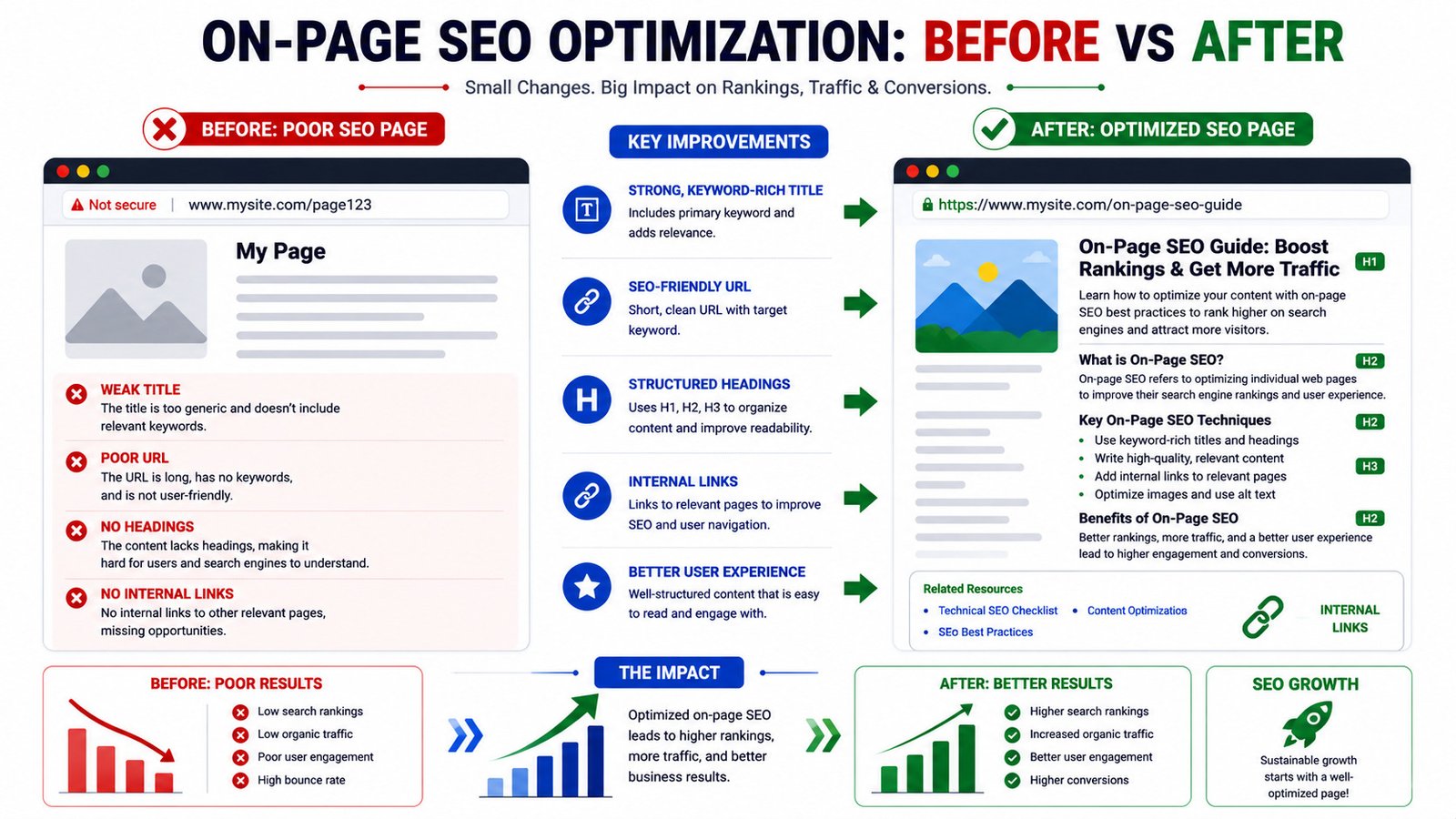
Are you searching for on-page SEO examples? It can help beginners learn how small changes can make webpages more effective for search engines and users.
Below is a brief comparison of a non-optimized page and an improved version.
Example:
Poorly Optimized Page
Name: Local Bakery Website
Original Page Title:
Home Page
URL: www.examplebakery.com/page1
Content: “Our bakery has multiple cake options. Contact us for more information about bread and cake.
Problems with the page:
Let us look at each issue on the page that affected search rankings and traffic.
Generic page title
Search engines cannot understand page topics when they are too generic.
Poor URL structure
The URL provides no context for the page’s content.
Weak content
The page lacks useful content that can provide visitors with information and depth.
Lack of target keyword
There are no relevant keywords and search terms in the content that can drive visitors to the page.
Weak readability
The content is too vague and lacks the basic SEO structure that helps search engines understand the topic.
No headings
Search engines and users cannot easily scan the page with proper heading distribution.
No internal links
Users cannot explore other related pages because no internal links are added to the page.
This webpage offers very little value to users. In addition, it signals weak relevance to the search engines.
Example 2: SEO-Optimized Version of the website
Here, let us understand how applying basic on-page SEO can improve page visibility and rankings.
Title of Web page:
Custom Birthday Cakes in Mumbai | ABC Bakery
Optimized URL:
www.abcbakery.com/custom-birthday-cakes-mumbai
Optimized Content Structure:
ABC Bakery brings you custom birthday cakes for a wide array of celebrations. We offer birthday cakes for adults to cakes for special events. We at ABC offer an excellent selection across Mumbai. Choose from fruit, chocolate, designer, and eggless cake options made with fresh ingredients.
Why Customers Choose Us?
- Quick delivery
- Personalized designs
- Variety of Options – Eggless and vegan
- Quality ingredients
- Online order options
Explore More Bakery Options
- Cupcakes
- Wedding cakes
- Party deserts
- Fresh bread
- Improvements incorporated
Here is a run-through of the improvements made through SEO optimization:
- Title with keyword focus
- It improves the search relevance and CTR
- Clearer URL
- Assists the search engine in understanding the page’s content.
- Proper headings
- Enhances the structure and readability
- Useful content
- Properly detailed information helps users understand the business and its offerings.
- Internal links
- Encourages users to explore similar pages on the website.
- Proper formatting
- It makes it easy for the users to scan the content.
- Local keyword targeting
- Improves visibility for local searches.
What The Examples Provide
These on-page SEO examples demonstrate the effectiveness of optimizing the page, beyond merely adding keywords. It includes refining the structure, readability, relevance, and visitor experience.
A well-optimized page assists:
- The search engine to understand the content
- It helps users find quick answers
- It helps businesses attract more traffic through organic search
Simple, minor changes to the content, such as improved headings, clearer URLs, and stronger content structuring, can improve overall SEO performance over time.
On-Page SEO vs Off-Page SEO
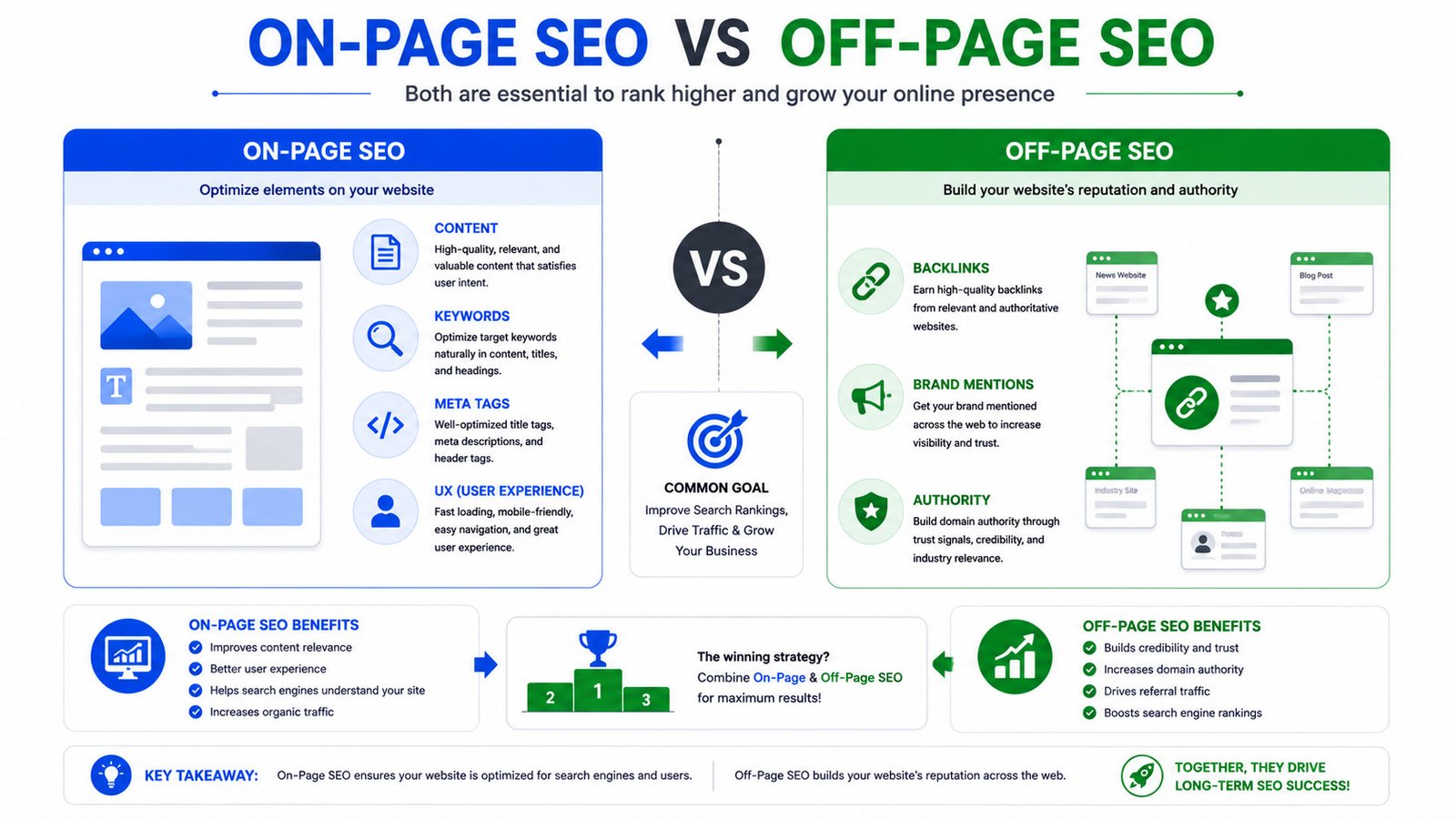
Knowing the basic differences between on-page and off-page SEO is crucial for an effective SEO strategy.
Both help improve search rankings; however, on-page and off-page SEO focus on two separate areas of SEO.
On-page SEO focuses on changing elements on the website. On the other hand, off-page SEO focuses on external signals such as building authority and trust.
Here is a brief comparison of On-page SEO and Off-page SEO
| Element | On-Page SEO | Off-Page SEO |
| Definition | It is an optimization performed within the website. | It is external website optimization. |
| Focus | On-page SEO focuses on improving the content quality, structure, and user experience. | Off-page SEO works on authority, site reputation, and trust. |
| Key elements | On-page SEO includes keywords, titles, meta descriptions, headings, internal links, and page speed. | Off-page SEO deals with backlinks, social signals, and brand mentions. |
| Control level | In on-page SEO, the control is fully in the hands of the website owner. | In off-page SEO, it is influenced by audiences and external websites. |
| Purpose | Assists search engines in learning the relevance of the content. | Whereas, off-page helps search engines to evaluate the overall credibility of the website. |
| Examples | Examples of good on-page SEO are optimized blog posts, a mobile-friendly design, and metadata. | Examples of good off-page SEO are backlinks, guest posts, and influencer mentions.
|
| Impact on SEO | On-page SEO improves content quality and usability | Off-page Seo builds domain authority and trust. |
Difference in Roles
On-page SEO helps search engines better understand what the webpage provides to users. It focuses on improving the quality of the content, the keywords used, and the readability, as well as the page structure, and works on the technical elements to improve the user experience.
On the other hand, off-page SEO helps build a website’s reputation. When trusted websites link to your website pages, search engines view your website as authoritative.
For example:
- On-page SEO helps the page rank using relevant keywords.
- Off-page SEO strengthens a website’s credibility and is essential for competing with other pages.
How to Use On-Page and Off-Page SEO Together
Both on-page and off-page SEO are important for overall SEO success. Strong on-page SEO helps provide good-quality content to users. Whereas off-page SEO helps increase overall visibility and build content authority through backlinks and online mentions.
Without on-page SEO, search engines cannot understand your content. On the other hand, without off-page SEO, even the most well-optimized pages will struggle to compete with other search results.
Hence, using a balanced SEO strategy including both types will help improve rankings, traffic, and online authority.
Best Practices for Long-Term On-Page SEO Success
Following on-page SEO best practices is essential to maintaining strong rankings on digital platforms. As search engine algorithms continue to evolve, SEO strategies should also evolve accordingly. These practices will depend on how much value you want to create with your content, whether the post is user-focused, and whether it supports a strong website experience.
Topical Authority
Topic authority is the process of creating deep, reliable content focused on a specific subject. Rather than creating isolated pages targeting random keywords, it is best to publish content that covers a particular topic in greater depth.
For example, an SEO website can go on to create detailed pages catering to:
- Keyword relevance
- Keyword research
- On-page SEO
- Off-page SEO
- Link building
- Local SEO
These help search engines better recognize your site and content. Along with it, it determines if your website is a trustworthy source within the particular niche.
User-Intent Content
Modern SEO techniques are heavily dependent on user intent. Thus, creating content that is more user-centered and search-focused requires a good understanding of what users are searching for.
For example, the search may differ for users who may look for:
- Informative content
- Comparative analysis
- Tutorials
- Pricing
- Product/service recommendations
Pages that serve users with content-rich intent are likely to rank higher in search results. Instead, those who focus solely on placing keywords, on content that balances the keywords, and on answering user questions are likely to be pulled by the search engine to rank them.
Updating Content Regularly
Content freshness and uniqueness are the core of long-term SEO performance. Updating older pages helps maintain website relevance and accuracy. It also helps in strengthening the rankings.
Your content strategies must include:
- New statistics
- Improving the overall readability
- Expanding sections
- Refreshing and refining outdated information
- Updating keywords
- Fixing broken links
- Improving the keywords
Regularly updating the content also signals to the search engine that the website is active and well-maintained.
User Experience (UX)
One on-page SEO ranking factor concerns the overall user experience the website provides. Search engines prefer webpages that are easy to use, load quickly, and are mobile-friendly.
Your UX optimization strategy must include:
- Enhancing faster page loading
- Making the webpage responsive to mobile design
- Clear navigation across pages
- Readable formatting
- Structuring the pages
- Accessible design
When users visit the page, they must stay longer and also interact with it positively. Search engines interpret these factors and elements as a sign of a high-quality, relevant website.
For long-term on-page SEO success, it is necessary to combine strong content, technical optimization, and an evolved user experience rather than relying solely on outdated ranking tricks.
FAQS About On-Page SEO
Q1. Can on-page SEO alone help a website rank?
On-page SEO is essential. However, it must be combined with off-page SEO to achieve good search results. Optimizing properly can help search engines understand your content and improve the user experience.
However, off-page SEO factors, such as domain authority and backlinks, also influence rankings.
For low-competitive topics, strong on-page SEO can help them rank in search results. But for highly competitive industries, a combination of on-page and off-page SEO strategies is required to get results.
Q2. How regularly should we update on-page SEO?
You do not need to follow a fixed schedule for updating pages. However, it is important to review the pages every few months. Content should be updated when:
- When the information is outdated
- When the rankings are low
- When the search intent changes
- When the trends in the industry evolve
- When there are new competitors
Herein, regular updates will help maintain content relevance and improve long-term SEO performance.
Q3. How long does on-page SEO take to show results?
On-page SEO will take significant time to show results. Small improvements will be seen in the performance within weeks, but a stronger ranking will take several months to show results, based on:
- Keyword competition
- Website authority
- Quality of content
- Frequency of crawling
- Overall SEO strategy
SEO is a long-term technique. It requires consistent optimization and regular improvements to deliver the best results.
Q4. What are the factors that matter for on-page SEO?
There are no single ranking factors that lead to success. However, high-quality content is the most important factor influencing SEO signals. Strong content must include:
- Useful information
- Align with user intent
- Be readable
- Include relevant keywords
- Offer user experience
Other essential factors include mobile responsiveness, page speed, title tags, internal linking, and overall website structure.
How does page speed affect on-page SEO?
Page speed impacts the user experience. A page that loads slowly can frustrate visitors. It can thereby increase the bounce rates and reduce the overall engagement.
Search engines like Google value fast-loading websites. These are responsive on different devices, including mobile.
A fast-loading website helps users access information effectively and improves overall browsing.
These should include:
- Compressing images
- Removing unnecessary scripts
- Browser caching
- Helping to improve server performance
- Using a responsive design
Faster pages support higher rankings, improving conversions, session duration, and website usability.
Conclusion
On-page SEO is the base of a website strategy. All elements, including title tags, keywords, internal linking, and readability, play an important role in helping search engines better understand pages and improve the overall user experience.
In this guide, we have comprehensively covered all important aspects of on-page SEO, which include:
- What on-page SEO means
- Why on-page SEO is important for ranking
- Ways search engines evaluate content
- Core elements for SEO Optimization
- Mistakes to avoid
- Beginner SEO tips
An effective SEO is about presenting clearer, more valuable, and better-organized content that meets user needs.


Ankita Gupta
Our Founder
Ankita founded Words And Cappuccinos to prove that good writing is a business asset, not a line item. She leads strategy across every account.